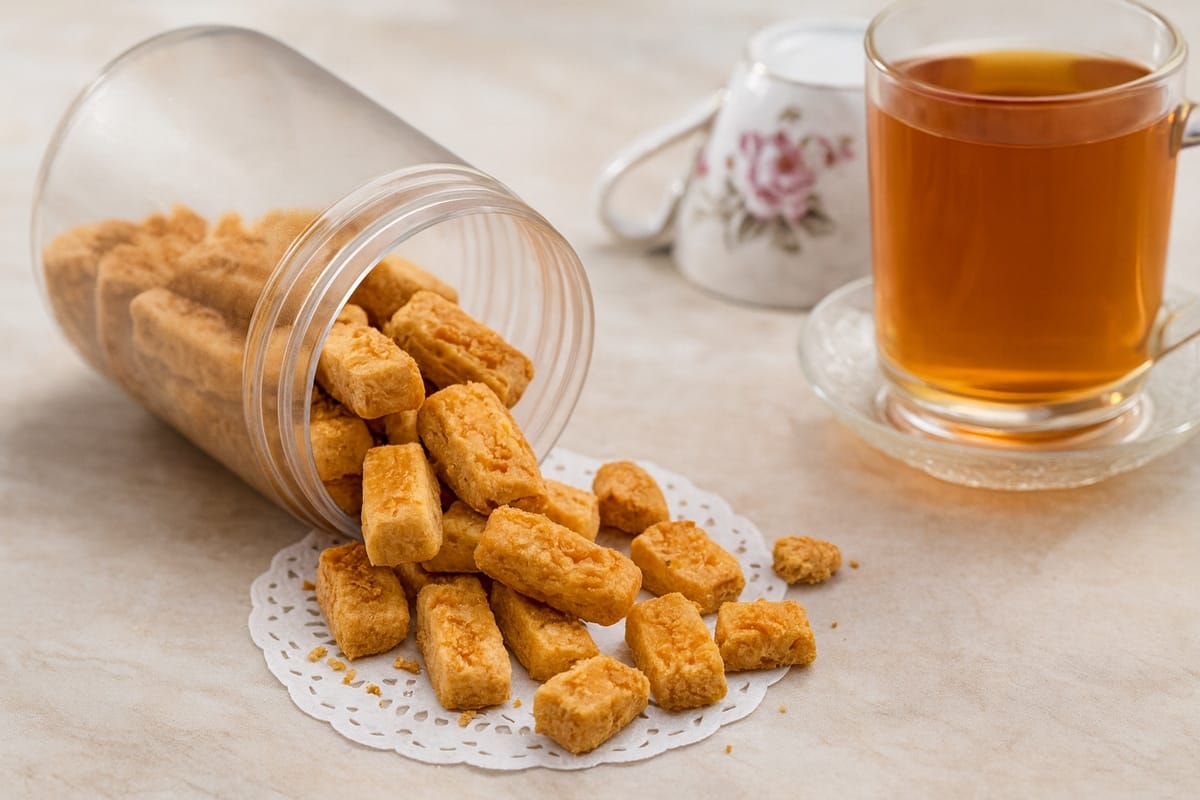
Kastengel is one of the must-have cookies during Eid celebrations in Indonesia. It also happens to be my wife’s all-time favorite—so much so that she’ll claim an entire jar just for herself.
Me? I’ve never been a big fan of savory cookies. Kastengel is rich, salty, and crumbly with grated cheese baked on top. Because it leans fully savory, it’s honestly not my first choice. I don’t know why, but it just never clicked with me.
Still, I can be objective enough to say it’s undeniably delicious—and that’s exactly why I feel it deserves to be shared with you.
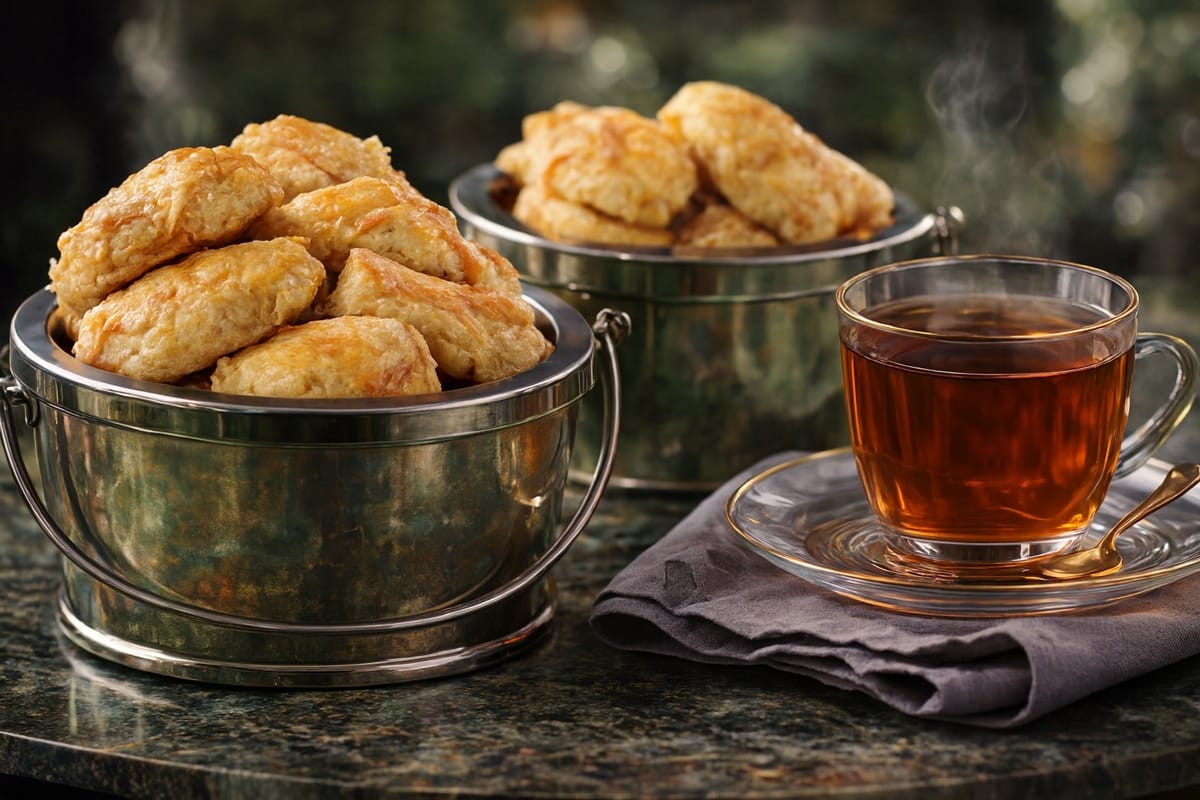
Indonesian Cheese Cookies (Kastengel)
Ingredients
Instruction
- Prepare the ingredients.Preheat the oven to 300–320°F (150–160°C). Line a baking sheet with parchment paper. Grate both types of cheese.
- Cream the fats.In a large bowl, beat unsalted butter and margarine until smooth and creamy (1–2 minutes).
- Add the aged cheese.Stir in the grated aged cheese (keju tua) until evenly combined.
- Add egg yolks.Mix in the 2 egg yolks just until incorporated. Do not overmix.
- Add dry ingredients.Add flour and cornstarch. Fold gently with a spatula or your hands until the dough comes together.The dough should be soft but not sticky.
- Chill the dough.Wrap and refrigerate for 15–30 minutes so the dough firms up and bakes evenly.
- Shape the cookies.Roll the dough to about ½ inch (1 cm) thickness. Cut into short rectangular sticks or use small cookie cutters.Place them on the baking sheet.
- Brush and top.Brush the tops with egg yolk. Sprinkle grated cheddar cheese generously.
- Bake.Bake for 20–30 minutes, checking at minute 20.Cookies should turn light golden on the surface without browning too much.
- Cool.Let the cookies cool fully—this helps them firm up and improves the texture.
Notes
Cheese Substitutions
-
Keju Tua (Indonesian aged cheese) can be replaced with:
- Aged Gouda
- Edam
- Parmesan
-
Grana Padano
The flavor will differ slightly, but all give the signature salty-savory richness.
Butter + Margarine?
Indonesian kastengel traditionally mixes butter + margarine for:- Better aroma
- Firmer structure
- A slightly crisp, less crumbly texture
Why Cornstarch (Maizena)?
It lightens the dough and gives that signature tender-crumb texture.Do not skip it.
Shaping Tip
Kastengel is not meant to rise.Keep shapes short and thick (not long), so they hold their form.
Storage
Store in an airtight jar for up to 10–14 days.For long-term storage, freeze baked cookies for up to 2 months.
The Origins of Cookies in Indonesia: A Dutch Legacy
To understand kastengel, we must first understand how cookies—locally called kue kering—became part of Indonesian food culture in the first place.
Indonesia did not originally have a tradition of oven-baked cookies. The concept of buttery pastries, breads, and baked goods entered the archipelago during the colonial era under the influence of Belanda. Dutch settlers brought with them European baking traditions, along with ingredients that were once considered luxury goods in the tropics: butter, margarine, aged cheeses, refined flour, and ovens large enough for bread.
What happened afterward was a classic example of culinary fusion.
Dutch households living in the archipelago employed local Indonesian cooks who began learning European baking techniques. Over time, these cooks adapted, altered, and reinvented Dutch pastries to suit local tastes, ingredients, and limitations—giving birth to a new category of treats known as kue kering.
This fusion explains why Indonesian festive cookies resemble European Christmas cookies in shape and technique… yet taste uniquely Indonesian.

Kastengel: One of Indonesia’s Most Iconic Holiday Cookies
Among all the baked goods adopted from Dutch culinary heritage, kastengel stands out as one of the most adored. Today, you’ll find it everywhere during Eid, Christmas, and Chinese New Year—lined neatly inside glass jars on living room tables, ready to welcome guests.
In Indonesia, kastengel holds the same emotional weight that shortbread holds in Scotland or gingerbread holds in the U.S. It is festive, nostalgic, social, and deeply tied to celebration.
Among all the baked goods adopted from Dutch culinary heritage, kastengel stands out as one of the most adored. Today, you’ll find it everywhere during Eid, Christmas, and Chinese New Year—lined neatly inside glass jars on living room tables, ready to welcome guests.
In Indonesia, kastengel holds the same emotional weight that shortbread holds in Scotland or gingerbread holds in the U.S. It is festive, nostalgic, social, and deeply tied to celebration.
Tracing the History: From Dutch Kaasstengels to Indonesian Kastengel
The name itself reveals the cookie’s origin. Kastengel comes from the Dutch word kaasstengels—literally “cheese sticks,” from kaas (cheese) and stengels (sticks).
Here’s a breakdown of its journey across continents:
1. Birthplace: The Netherlands
In its original form, kaasstengels in Belanda were not small cookies but long cheese breadsticks up to 30 centimeters (about 12 inches). They were served like French baguette slices—paired with soup or salad, more similar to savory breadsticks than cookies.
2. Introduction to Indonesia During Colonial Rule
Kaasstengels arrived in the archipelago along with European settlers and became a specialty served in upper-class colonial homes. They were offered to dignitaries, Dutch families, and elite households—often prepared by local Indonesian cooks who mastered Dutch recipes.
3. Adaptation in Indonesian Homes
When Indonesian or mixed-heritage cooks tried making kaasstengels at home, they faced a practical issue:
Traditional Dutch ovens were far larger than Indonesian home ovens.
As a result:
- The cheese sticks were cut shorter
- Portions became bite-sized
- The texture shifted from bread-like to cookie-like
- More butter and margarine were added
- Toppings were adapted to local cheese availability
This evolution transformed kaasstengels into the uniquely Indonesian kastengel we know today: small, golden, salty-savory cheese cookies about 3–4 cm long.
4. A Strange Historical Footnote: Used as Currency
In the Dutch village of Krabbedijke, kastengel once held such value—due to the use of expensive aged cheeses—that they were reportedly used as barter items.

It’s a charming reminder of how prized cheese once was in European society.
5. Indonesian Kastengel Becomes a Holiday Icon
Over time, kastengel detached from its Dutch holiday associations and became a staple of Indonesian Muslim celebrations. Today, it sits proudly beside other holiday cookies like nastar (pineapple tarts) and putri salju (sugar-coated butter cookies).
Cultural Context — The Indonesian Touch
What makes Indonesian kastengel truly unique goes far beyond its smaller size or festive shape. The cookie carries cultural layers that have become deeply woven into Indonesian celebrations. It symbolizes warmth and hospitality, where a full jar on the living room table is more than decoration—it’s a gesture of welcome for anyone who walks through the door.
Kastengel also reflects Indonesia’s long history of adapting European culinary traditions into something distinctly local, from using a mix of cheddar with Edam or Parmesan to integrating the cookie into the social rhythm of Eid visits. Over generations, it has evolved into a symbol of festive generosity and a familiar presence during holiday gatherings. In this way, kastengel is far more than a snack—it’s a tradition that connects families, neighbors, and cultural histories.
Flavor Philosophy — Why It Works
The appeal of Indonesian kastengel lies in a flavor profile not commonly found in Western cookies. It is buttery like shortbread, yet boldly cheesy in a way that recalls savory crackers. Instead of sweetness, it leans into saltiness, creating a rich balance that feels both indulgent and comforting. Cornstarch adds a delicate, tender crispness that makes each bite melt just slightly before giving way to a pleasant crunch. This combination places kastengel somewhere between a cookie, a cracker, and a pastry—a hybrid that feels familiar yet intriguingly different. It’s this very duality that captures the hearts of Indonesians and piques the curiosity of Western bakers experiencing it for the first time.
How Indonesian Kastengel Differs From Dutch Kaasstengels
| Aspect | Dutch Kaasstengels | Indonesian Kastengel |
|---|---|---|
| Length | Up to 30 cm | 3–4 cm |
| Texture | Bread-like, chewy | Cookie-like, crumbly |
| Serving style | With soup/salad | As festive cookies in jars |
| Cheese type | Gouda, Edam | Gouda + Cheddar mix common |
| Flavor | Mild savory | Strong cheese aroma, richer fat profile |
Is Indonesian Kastengel Known in the West Today?
Not widely—at least not yet.
While Dutch kaasstengels are known in European bakeries, the Indonesian adaptation is still relatively niche in the U.S. and Europe. However, as Indonesian cuisine gains traction—especially in cities like Amsterdam, London, and Los Angeles—kastengel is slowly making its way into international food conversations.
Its flavor profile actually suits Western palates extremely well. If Americans already enjoy Cheez-Its, cheddar biscuits, cheese crackers, and shortbread, kastengel is a natural next fascination.
Can You Make Kastengel in the West? Absolutely.
Most ingredients are easy to find in Western grocery stores:
- Butter
- All-purpose flour
- Egg yolks
- Cornstarch
- Aged Gouda, Edam, Parmesan
- Cheddar for topping
What Might Be Challenging?
- Finding Edam or Dutch cheeses in smaller towns
But substitutes like aged Gouda or Parmesan work beautifully. - Balancing butter and margarine
Indonesians often use margarine for aroma and firmer texture.
In the West, margarine varies by brand—so the texture might differ slightly. - Shaping technique
The dough is soft and rich; chilling helps a lot.
Tips for Western Kitchens
- Chill the dough 20–30 minutes for cleaner cuts
- Use parchment paper to prevent over-browning
- Add 10% Parmesan for sharper flavor
- For a more American twist, add smoked cheddar on top
- Bake low and slow at 300–320°F for perfect golden edges
How to Serve Kastengel for Western Tastes
Kastengel fits surprisingly well into Western dining and entertaining traditions, making it easy to integrate into everyday moments or special gatherings. Its buttery–cheesy character pairs beautifully with warm drinks, especially black tea, Earl Grey, or a smooth cup of coffee like a flat white or café au lait. For those who enjoy wine, kastengel complements light whites such as Chardonnay or Riesling, adding a savory contrast that feels sophisticated without being fussy.
When used for entertaining, kastengel can be placed alongside a cheese platter, served beside a comforting bowl of soup—echoing its Dutch roots—or added into a mixed holiday cookie box to offer guests something unexpected and savory. It even works well as a simple, satisfying snack for game nights or casual gatherings.
Because kastengel keeps well for up to two weeks in an airtight jar, it also makes an excellent edible gift. Whether tucked into a Christmas basket or presented as a hostess offering, it brings a touch of Indonesian warmth to any occasion.

Why You Should Try Making It
If you enjoy:
✔ cheese crackers
✔ butter cookies
✔ savory pastries
✔ or culinary stories that span continents
…then kastengel is a must-try.
It’s one of those recipes that captures history, adaptation, and cultural identity in every bite. Plus, it’s surprisingly simple to make—even for beginners.
Final Invitation
Kastengel may not be my personal favorite—but it is one of Indonesia’s most culturally rich cookies, packed with history from colonial kitchens to modern festive traditions. And if my wife’s love for this cookie is any indicator, many people easily fall in love with it.
So why not give it a try?
Make a batch in your own kitchen, taste this piece of Indonesian-Dutch culinary history, and share your experience—your version might become a new family tradition wherever you are in the world.