Indonesian Grilled Eggplant with Fresh Basil Sambal, locally known as Terung Bakar Sambal Kemangi, is a humble yet deeply expressive dish from Indonesia’s vast culinary landscape. Made from fire-roasted eggplant mashed with chilies, candlenuts, tamarind, and fresh lemon basil, this dish reflects a side of Indonesian cooking that is often overshadowed by richer curries and stews: simplicity, freshness, and respect for natural ingredients.
In an era when global audiences are increasingly drawn to plant-forward, flavor-driven food, Terung Bakar Sambal Kemangi feels surprisingly modern—despite its roots in traditional Indonesian home cooking.
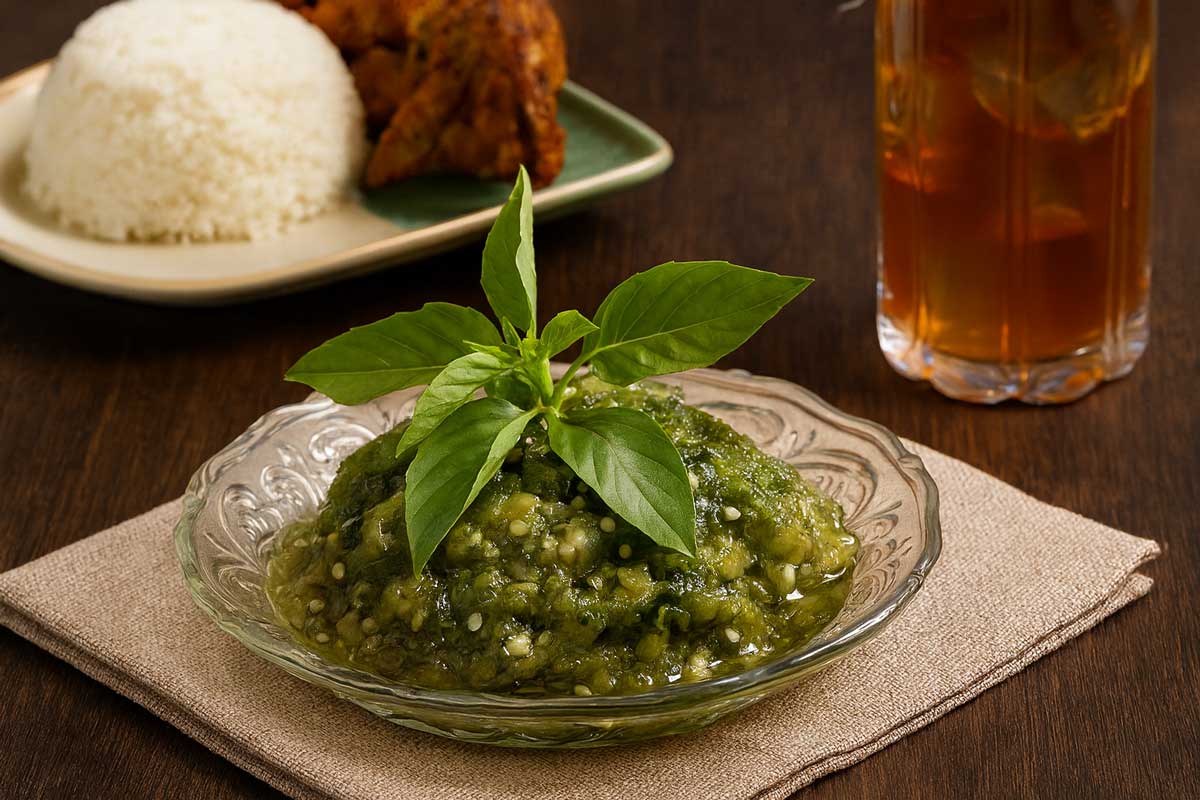
Indonesian Grilled Eggplant with Fresh Basil Sambal (Terung Bakar Sambal Kemangi)
Ingredients
Instruction
- Grill the eggplant and chilies directly over an open flame, grill pan, or broiler until the eggplant skin is charred and the flesh is soft. The chilies should blister and soften.
- Let the eggplant cool slightly, then peel off the charred skin. Scoop out the soft flesh and place it in a mortar or mixing bowl.
- Using a mortar and pestle, grind the candlenuts and salt into a coarse paste. Add the grilled chilies and continue grinding.
- Add the grilled eggplant flesh and gently mash until combined but still slightly chunky.
- Stir in the tamarind water, adjusting acidity to taste.
- Transfer to a serving plate and top with fresh lemon basil leaves. Serve at room temperature.
Notes
- Eggplant choice: Standard American globe eggplant works perfectly. Italian eggplant is also suitable.
- Chili heat: For mild heat, use jalapeño and remove seeds. For more spice, use serrano chilies.
- Candlenut substitute: Candlenuts are toxic when raw; always cook them. Macadamia nuts or cashews provide a similar creamy texture.
- No mortar & pestle? A fork or potato masher works well—avoid food processors to preserve the rustic texture.
- Serving ideas: This dish pairs beautifully with grilled chicken, lamb, steak, or fish, and also works as a plant-based spread for flatbread.
- Make it vegan & gluten-free: Naturally vegan and gluten-free with no modifications needed.
- Substitution: If unavailable, use Thai basil, or combine sweet basil with a small amount of fresh lemon zest to mimic kemangi’s fresh citrus note.
- Avoid dried basil, as it lacks the bright aroma needed for this dish.
- Add the basil just before serving to preserve its fresh fragrance.
A Dish Without a Single Homeland—And Why That Matters
Unlike iconic Indonesian dishes such as Rendang from West Sumatra or Coto Makassar from South Sulawesi, Terung Bakar Sambal Kemangi does not belong to one single region. Instead, it sits within a broader Indonesian tradition of grilled vegetables (lalapan bakar) paired with freshly prepared sambal.
This is important to understand:
In Indonesia, not every beloved dish is “khas” (officially tied to one region). Many recipes exist across regions, adapting slightly to local tastes, ingredients, and customs. Terung Bakar Sambal Kemangi is one of them.
Regional Narratives That Shape the Dish
West Java (Sundanese Influence)
In West Java, particularly within Sundanese culinary traditions, grilled vegetables are an essential part of everyday meals. Eggplant is often fire-roasted and served as part of lalapan, accompanied by freshly made sambal and an abundance of raw herbs. Sundanese cooking places a strong emphasis on freshness, balance, and herbal aroma, rather than heavy spice blends or prolonged cooking.
Here, daun kemangi (lemon basil) plays a central role. Its bright, citrusy fragrance is used to lift sambal and grilled vegetables, creating a light and refreshing flavor profile. In this context, dishes resembling Terung Bakar Sambal Kemangi are not defined by a single formal recipe, but by a shared habit of preparing simple, fresh sambal to accompany grilled vegetables at home.
South Sulawesi (Bugis–Makassar Context)
While the Sundanese approach highlights freshness and herbal notes, South Sulawesi cooking—particularly among the Bugis people—reflects a different flavor philosophy. One traditional preparation often cited in this context is Posso’ Itterung, a dish of grilled eggplant mashed with simple seasonings. Although ingredient lists vary between households, the technique of fire-roasting eggplant and combining it with sambal is deeply rooted in Sulawesi home kitchens.

However, classical Bugis–Makassar dishes generally build flavor through a more robust savory structure, commonly developed using:
- Bawang merah (shallots) and bawang putih (garlic) as foundational aromatics
- Fermented or cooked seafood elements, such as shrimp paste, to enhance umami
- Cooking methods that layer flavor, including sautéing and extended heat
Because of these distinctions, Terung Bakar Sambal Kemangi is best understood as a cross-regional expression of Indonesian home cooking—sharing techniques with South Sulawesi traditions, yet aligning more closely in flavor profile with the herb-forward, fresh approach found in West Java.
Why Not the Original Posso’ Itterung—or a Strictly Sundanese Version?
At this point, another fair question emerges: why not prepare the dish in its traditional Bugis form, or clearly present it as a Sundanese recipe?
The answer lies in how Indonesian home cooking actually works—fluid, adaptive, and deeply shaped by context.
The original Posso’ Itterung from South Sulawesi is inseparable from the Bugis pantry. It often includes sautéed aromatics, a stronger savory foundation, and sometimes fermented seafood ingredients that build depth and umami. These elements are natural in Sulawesi kitchens but can be difficult to source or unfamiliar to many home cooks outside Indonesia. Reproducing the dish faithfully would require not only the ingredients, but also an understanding of the local flavor balance that gives it meaning.
On the other hand, a strictly Sundanese version would lean heavily on lalapan culture—where grilled eggplant is served alongside raw vegetables and freshly made sambal, often without being mashed into a single preparation. In Sunda cuisine, kemangi shines as a fresh herb, but the dish itself is usually part of a broader table setting rather than a standalone recipe.
This version, Terung Bakar Sambal Kemangi, sits intentionally between those two traditions. It borrows the hands-on, fire-roasted technique familiar in South Sulawesi, while embracing the light, herb-forward sensibility associated with West Java. The result is not a regional claim, but a practical expression of Indonesian cooking as it is lived: adjusted, simplified, and shaped by what feels right in the moment.
In many Indonesian homes, such choices are not viewed as departures from tradition, but as everyday creativity. Cooking this version is less about choosing sides, and more about honoring a shared culinary habit—making something satisfying, accessible, and deeply comforting with what is on hand.
Across the Archipelago: A Shared Home-Cooking Practice
From Java to Sumatra and Sulawesi, Indonesians commonly grill vegetables directly over fire—often using simple charcoal stoves—and mash them with chilies and salt. This method predates modern kitchens and reflects a pre-colonial cooking logic: cook quickly, season minimally, and let the ingredient speak.
Food historians and Indonesian culinary writers such as Bondan Winarno often emphasize that sambal-based dishes are more about technique and habit than rigid regional borders.

Flavor Profile: Why It Works
Terung Bakar Sambal Kemangi delivers a layered yet approachable flavor:
- Smoky from the fire-roasted eggplant
- Soft and creamy from candlenuts (kemiri)
- Bright and tangy from tamarind
- Fresh and citrusy from kemangi (lemon basil)
- Gentle heat from green chilies
This balance makes it especially appealing to Western palates that enjoy grilled vegetables, Mediterranean-style spreads, or Middle Eastern mezze.
How It’s Served in Indonesia
In Indonesia, this dish is rarely eaten on its own. It is typically served:
- As a side dish with steamed rice
- Alongside grilled fish or fried chicken
- As part of a larger spread of sambal, vegetables, and protein
It is casual, unpretentious, and deeply tied to everyday family meals rather than ceremonial occasions.
Serving Ideas for Western Kitchens
For American and European home cooks, Terung Bakar Sambal Kemangi can be reimagined without losing its soul:
- Serve as a smoky eggplant spread with flatbread or sourdough
- Pair with grilled lamb, steak, or roasted chicken
- Use as a plant-based side for summer barbecues
- Add to a mezze-style platter with olives and yogurt dip
Because it’s naturally vegan and gluten-free, it fits seamlessly into modern dietary preferences.
Understanding Kemangi (Lemon Basil)
One key ingredient deserves special attention: daun kemangi.
Kemangi is not the same as Italian sweet basil. It has a distinct citrusy, slightly peppery aroma. In the U.S. and Europe, it is not commonly found in mainstream supermarkets but may appear in Southeast Asian grocery stores under names like lemon basil or Thai lemon basil.
Substitutions that work:
- Thai basil
- Sweet basil combined with a small amount of fresh lemon zest
Avoid dried basil—it lacks the fresh aromatic quality essential to this dish.
Nutritional Benefits
Terung Bakar Sambal Kemangi is not only flavorful but also nutritious:
- Eggplant is high in fiber and antioxidants
- Candlenuts add healthy fats and satiety
- Chilies contain capsaicin, known for metabolic benefits
- Basil provides natural antibacterial and anti-inflammatory properties
With minimal oil and no animal products, it’s a light yet satisfying addition to any meal.
Why This Dish Resonates Today
In a global food culture increasingly focused on authenticity, sustainability, and home cooking, Terung Bakar Sambal Kemangi tells a compelling story. It reminds us that not all traditional dishes are elaborate or regionally rigid—some exist simply because they make sense.
They are born from fire, necessity, and shared taste memory.
An Invitation to Cook and Share
Cooking Terung Bakar Sambal Kemangi is an invitation to experience Indonesian food beyond famous names. It encourages you to slow down, grill something simple, mash it by hand, and taste as you go.
If you try this recipe, share your version:
- Did you use Thai basil or lemon zest?
- Did you serve it with grilled meat or bread?
- How did you adapt it to your kitchen?
Indonesian cuisine lives not only in tradition, but in adaptation and storytelling—and your kitchen can be part of that story.