Lapis Legit (Indonesian Thousand-Layer Spiced Butter Cake / Spekkoek)
✨ Key Takeaways
- The Lapis Legit recipe requires patience, using 25 egg yolks and 400g of butter for a dense, velvety texture.
- This cake is a colonial-era fusion of European creaming techniques and aromatic Maluku spices like nutmeg and cinnamon.
- Baking involves grilling thin layers individually under a broiler to create the signature caramelized stripes.
- It is traditionally served in thin slices with strong black coffee or unsweetened tea to balance the richness.
The Lapis Legit recipe is a labor of love that combines 25 egg yolks, butter, and warm Indonesian spices. Each thin layer is individually grilled to create a dense, aromatic cake with caramelized stripes. This festive dessert, also known as Spekkoek, is a symbol of prosperity and is best enjoyed in small slices with strong coffee.
Discover the authentic Lapis Legit recipe that transforms simple ingredients into a luxurious, spiced masterpiece. Twenty-five egg yolks, nearly a pound of butter and margarine, a fragrant blend of warm Indonesian spices, and more than a dozen paper-thin layers grilled one by one—Lapis Legit is unapologetically extravagant. It is not a quick Tuesday-night dessert. It is the undisputed crown jewel of Indonesian baking, a cake so rich, velvety, and aromatic that a single thin slice feels like an occasion.
For Western home bakers, Lapis Legit (also known internationally by its Dutch name, Spekkoek) is a fascinating project. It requires no fancy pastry piping or fondant—just patience, a reliable oven broiler, and good butter. This traditional festive version takes things one step further by studding the spiced golden layers with toasted, jewel-toned kenari nuts (Indonesian canarium nuts), adding a delicate crunch to every melt-in-your-mouth bite.
The History and Cultural Roots of Lapis Legit
Lapis Legit is one of the most famous edible legacies of Indonesia’s colonial era, similar to the history behind Kue Lapis Pepe. Its story begins in the Dutch East Indies (Hindia Belanda) during the 19th century, when Dutch families settled in Java and began adapting European baking traditions to the ingredients available in the Indonesian archipelago.
According to Indonesian culinary historian Fadly Rahman in his acclaimed book Rijsttafel: Budaya Kuliner di Indonesia Masa Kolonial 1870–1942, Dutch colonial households longed for familiar European cakes—particularly rich, spiced butter cakes and German-style layered cakes. However, they had access to something Europe could only dream of in abundance: fresh, intensely aromatic Maluku spices—cinnamon, cloves, nutmeg, cardamom, and mace. Local Indonesian cooks working in colonial kitchens combined European creaming techniques with these warm archipelago spices, creating a dense, fragrant, multi-layered cake built specifically for tropical afternoon tea and grand banquets.
Over time, Lapis Legit transcended its colonial origins and became deeply woven into Indonesian national identity. As documented in the Ensiklopedia Kuliner Nusantara and celebrated by international culinary outlets like CNN Travel (which famously ranked Lapis Legit among the world’s best national cakes), the cake was embraced across Indonesia’s diverse communities. Today, it is an essential centerpiece for Eid al-Fitr (Lebaran), Lunar New Year (Imlek), Christmas, and milestone weddings.

Also check out:
Pecel Lele: Indonesia’s Beloved Crispy Catfish
The Name and Culinary Philosophy
The cake carries two iconic names, each telling a different side of its story:
- Lapis Legit (Indonesian): Lapis means “layer,” and legit describes a texture and flavor that is deeply rich, moist, sweet, and lingering on the palate. Together, the name promises a cake of indulgent, closely stacked layers.
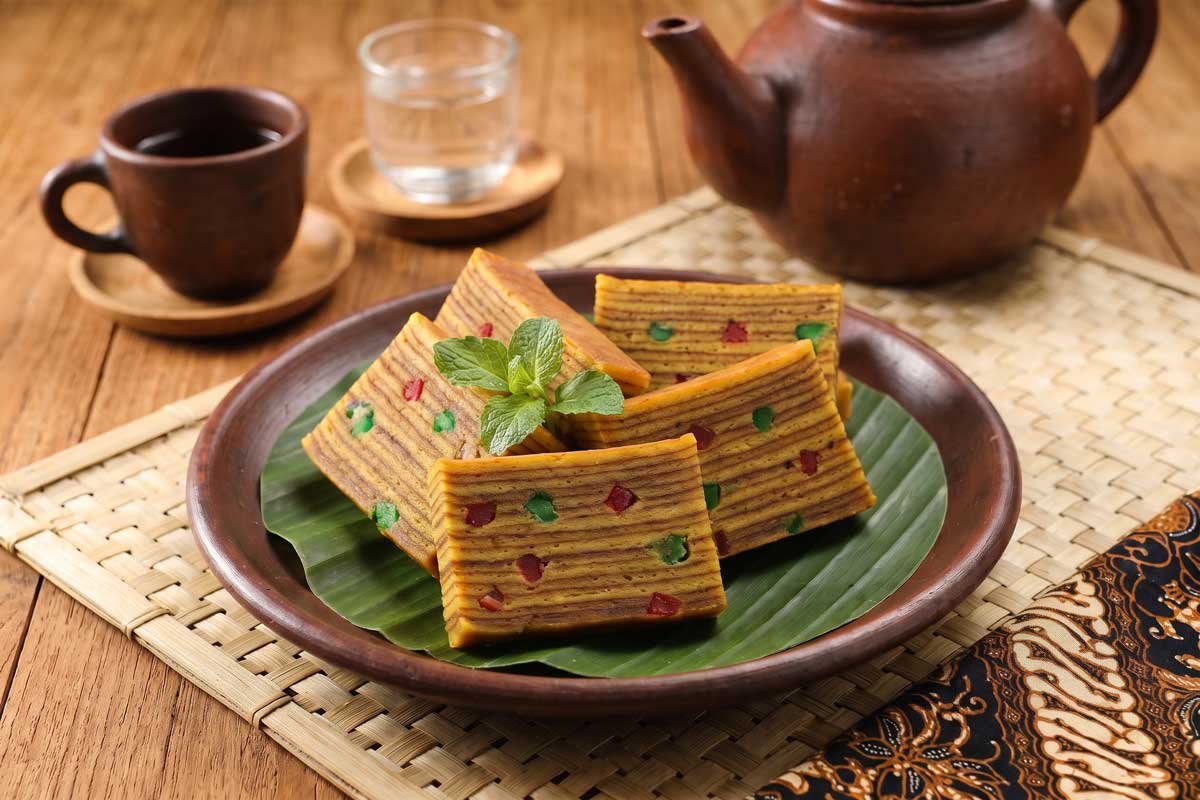
- Spekkoek (Dutch): Literally translating to “bacon cake” or “pork belly cake.” Despite the name, traditional Lapis Legit contains zero pork and is 100% halal. Dutch colonists coined the nickname purely for its visual appearance—when sliced, the alternating pale golden batter and deeply caramelized brown stripes resemble streaky layers of cured pork belly.
Philosophically, Lapis Legit is a symbol of prosperity, patience, and devotion:
- Layered Fortune (Rejeki Berlapis): Especially during Chinese New Year and Eid, gifting a whole Lapis Legit wishes the recipient layers upon layers of good health, wealth, and happiness in the coming year.
- A Labor of Love: Because each thin layer must be poured, leveled, pressed, and grilled individually over 60 to 90 minutes, baking Lapis Legit from scratch is considered one of the highest forms of hospitality in Indonesia.
Lapis Legit (Indonesian Thousand-Layer Spiced Butter Cake / Spekkoek)
An authentic, ultra-rich Indonesian celebratory layer cake made with 25 egg yolks, creamed butter and margarine, warm spekkoek spices, and festive toasted red-and-green kenari nuts, grilled layer by layer to golden perfection.
Ingredients
Instruction
- Prep the Pan & Nuts: Grease a 20 × 20 × 5 cm (8 × 8 × 2-inch) square baking pan with margarine and line the bottom with parchment paper (do not grease the sides heavily, so the cake grips and stays level). Toast the kenari nuts (or almonds) in a dry skillet until lightly golden, chop finely, and divide into two small bowls. Toss one bowl with 1 drop of red food coloring and the other with 1 drop of green food coloring. Set aside.
- Whip Mixture I (Butter Base): In a large mixing bowl, beat the margarine, butter, sweetened condensed milk, powdered sugar, and vanilla on medium-high speed for 8–10 minutes until completely smooth, pale, fluffy, and doubled in volume. Set aside.
- Whip Mixture II (Eggs): In a separate clean bowl, beat the 25 egg yolks and 2 egg whites on high speed for 6–8 minutes until thick, pale yellow, and ribbony.
- Combine & Fold: Gently fold the whipped butter mixture (Mixture I) into the whipped eggs (Mixture II) using a spatula until evenly combined. Gradually add the sifted dry ingredients (Mixture III) a little at a time, folding gently just until no flour streaks remain.
- Preheat the Broiler (Top Heat): Preheat your oven’s top heat / broiler to medium-low (approx. 180°C–190°C / 350°F–375°F) and position the oven rack in the middle-to-upper third.
- Bake the First Layer: Spread a thin, even layer of batter (about 1 to 2 generous tablespoons, or ~60g) across the bottom of the prepared pan using an offset spatula. Scatter a light pinch of red and green kenari nuts on top and gently press them in. Place under the top heat and bake for 3–5 minutes until golden-brown and set.
- Build Layer by Layer: Remove the pan from the oven. Gently press down any air bubbles using a flat lapis press (or the flat bottom of a greased glass/measuring cup). Spread the next thin layer of batter evenly on top, scatter more red and green nuts, and return under the top heat for 3–5 minutes until golden-brown. Repeat this process layer by layer until all the batter is used.
- Final Bottom-Heat Bake: Once the very last layer is golden-brown on top, switch the oven to bottom heat (conventional bake) at 170°C (340°F) and bake for a final 10 minutes to ensure the center is thoroughly cooked and set.
- Cool & Slice: Remove from the oven and let the cake cool completely in the pan (at least 2 hours) before inverting onto a wire rack. For the cleanest stripes, wrap and rest overnight at room temperature before slicing into thin, neat rectangles.
Notes
- Room-Temperature Ingredients Are Crucial: Make sure your butter, margarine, and eggs are all at room temperature so the emulsion stays smooth and doesn’t curdle when combined.
- Pressing Each Layer: Gently pressing each freshly baked layer with a lightly greased flat press (or flat-bottomed glass) removes trapped air pockets and gives Lapis Legit its signature tight, even stripes.
- Watch the Broiler Closely: Every oven broiler runs at a different intensity. Stay near the oven during the first two layers to learn your exact timing—a layer can go from golden-brown to burnt in 30 seconds!
- Don’t Waste Those Egg Whites: You will have 23 leftover egg whites! Freeze them in an airtight container (they freeze beautifully for up to 3 months) and use them for macarons, pavlova, Swiss meringue buttercream, or healthy egg-white omelets.
- Storage: Because of its high butter and sugar content, Lapis Legit keeps wonderfully. Store tightly wrapped at room temperature for up to 5 days, or refrigerated for up to 2 weeks (bring to room temperature before serving so the butter softens).
What Does Lapis Legit Taste Like?
If you have never tasted Lapis Legit, forget everything you know about fluffy American sponge cakes. Lapis Legit is dense, silky, buttery, and intensely aromatic—closer in richness to a fine French pound cake (quatre-quarts) crossed with a spiced custard tart.
- Warm & Complex Spice: The signature bumbu lapis legit (spekkoek spice) wraps your palate in cinnamon, nutmeg, cloves, and cardamom. It feels cozy and nostalgic, reminiscent of holiday gingerbread or Dutch speculaas, yet far more delicate and buttery.
- Melt-in-Your-Mouth Richness: With 25 egg yolks and 400 grams of butter and margarine, the crumb is astonishingly tender and moist, dissolving almost effortlessly on the tongue.
- Caramelized Stripes: Grilling each thin layer under top heat creates micro-thin sheets of golden-brown caramelization between every layer, giving the cake a subtle, toasty depth.
- Nutty Crunch: In this festive recipe, toasted chopped kenari nuts (tinted red and green) break up the velvety crumb with a crisp, buttery snap.
How It Is Traditionally Served in Indonesia
Because Lapis Legit is extraordinarily rich, portion control is part of the ritual. In Indonesia, it is never cut into massive birthday-cake wedges. Instead, it is sliced into neat, slender rectangles or thin fingers (roughly 1 to 1.5 cm thick) so guests can savor the intricate stripes without feeling overwhelmed.
It is almost always served at room temperature alongside:
- Unsweetened Hot Black Tea (Teh Tawar) or Jasmine Tea: The clean tannins cut right through the butter and egg yolks.
- Strong Indonesian Black Coffee (Kopi Tubruk): A classic pairing for late-afternoon visits (ngopi sore).
When to Serve It
Lapis Legit is the ultimate celebration and gifting cake. It shines at holiday brunches, Christmas dessert tables, Lunar New Year gatherings, formal afternoon teas, and weddings. Even better, Lapis Legit actually tastes better the next day: resting overnight allows the butter and warm spices to meld, making the cake even more fragrant and easier to slice into razor-sharp stripes.
Can Lapis Legit Be Adapted Internationally?
Yes—and you do not need a specialty Indonesian charcoal-top oven (oven tangkring) to pull it off. A standard Western kitchen oven with a top broiler/grill element is all you need.
The secret to succeeding in a Western oven is managing the rack position and heat. Place your oven rack in the middle-to-upper third (not directly touching the broiler element) so each thin layer turns a rich golden-brown in 3 to 5 minutes without scorching. If your oven has a “Low Broil” setting (around 180°C–200°C / 350°F–400°F), use it—it gives you gentle, even top heat that mimics traditional Indonesian baking.

Also check out:
Putu Mayang: A Sweet Betawi Legacy with Global Appeal
Ingredient Substitutions for Western Supermarkets
You can bake an authentic Lapis Legit from any standard Western grocery store using these smart swaps:
Global Culinary Cousins: Similar Dishes Around the World
Lapis Legit sits in an elite global family of painstakingly layered, spit-roasted or broiled cakes:
- Baumkuchen (Germany & Japan): Often called the “Tree Cake,” German Baumkuchen is baked layer by layer on a rotating spit, creating tree-ring stripes. While Baumkuchen is lighter, airier, and lightly flavored with vanilla or rum, Lapis Legit is denser, richer in egg yolks, and heavily spiced.
- Kek Lapis Sarawak (Malaysia): A close regional cousin from Malaysian Borneo. Kek Lapis Sarawak uses a similar broiled-layer method, but bakers often cut and reassemble the baked layers into breathtaking geometric mosaics and incorporate flavors like cream cheese, pandan, and Horlicks.
- Bebinca (Goa, India): A Portuguese-influenced layered pudding cake made with coconut milk, egg yolks, ghee, and nutmeg. Like Lapis Legit, it is grilled layer by layer, though Bebinca has a denser, custard-like texture rather than a buttery cake crumb.
- Sękacz / Šakotis (Poland & Lithuania): Traditional spit-baked celebration cakes made with dozens of eggs and copious butter, sharing Lapis Legit’s festive wedding-cake status.
Nutritional Overview, Health Benefits, and Precautions
There is no point pretending Lapis Legit is a diet food—it is a celebratory, once-in-a-while indulgence! Based on 8 generous servings (though most people slice it into 16 thin pieces), one 1/8th portion contains approximately 645 kcal, 11g of protein, 46g of fat, and 49g of carbohydrates (or roughly 322 kcal for a traditional thin 1/16th slice).
Key Nutritional Highlights
- Nutrient-Dense Egg Yolks: Egg yolks are rich in choline (vital for brain health), vitamin A, vitamin D, vitamin B12, and lutein.
- Antioxidant Spices: Cinnamon, cloves, cardamom, and nutmeg are packed with polyphenols and warming aromatic compounds that aid digestion.
- Healthy Fats from Nuts: Kenari nuts (or almonds) contribute vitamin E, magnesium, and heart-healthy monounsaturated fats.
Precautions to Keep in Mind
- High in Cholesterol, Saturated Fat, and Sugar: With 25 egg yolks and 400g of butter/margarine, Lapis Legit is very high in calories, saturated fat, and dietary cholesterol. Enjoy it the authentic Indonesian way—in thin, mindful slices alongside unsweetened tea or coffee.
- Allergens: Contains eggs, dairy, wheat (gluten), and tree nuts.
Estimated Cost Breakdown (Western Supermarket)
Because of the high egg yolk count and quality butter, Lapis Legit is one of Indonesia’s pricier homemade cakes—which is exactly why it is reserved for special occasions. Here is a realistic cost estimate for 1 whole 20×20 cm cake (8–16 servings) in the US or Europe:
- 25–27 large eggs (using 25 yolks + 2 whites): $6.50 – $9.50 (save the leftover 23 egg whites for meringues, pavlova, or angel food cake!)
- 200g European-style butter + 200g baking margarine: $5.00 – $7.00
- 100g almonds / pine nuts / kenari nuts: $3.00 – $4.50
- Powdered sugar, sweetened condensed milk, flour, milk powder, cornstarch & spices: $4.00 – $5.50 (prorated)
- Total Estimated Cost: $18.50 – $26.50 per whole cake (roughly $1.15 – $1.65 per thin slice, or $2.30 – $3.30 per generous serving—still a fraction of the $50–$80 price tag at specialty bakeries!).
Frequently Asked Questions
What is the Lapis Legit recipe made of?
It is made with 25 egg yolks, butter, margarine, flour, powdered sugar, condensed milk, and a blend of warm spices like cinnamon and nutmeg.
Why is Lapis Legit called Spekkoek?
The Dutch colonists named it Spekkoek, meaning 'bacon cake,' because the sliced layers resemble the streaky appearance of cured pork belly.
Can I bake Lapis Legit in a standard home oven?
Yes, you can use a standard oven with a top broiler element. Place the rack in the upper third and use a low broil setting to mimic traditional baking.