More Than Just a Soup
If Indonesia had a national comfort food, Soto Betawi would be one of its proudest contenders. Imagine a creamy beef soup — rich with coconut milk, scented with cinnamon, lemongrass, and nutmeg — served steaming hot with emping crackers, lime wedges, and a spoonful of chili on the side. That’s Soto Betawi, the soul of Jakarta in a bowl.
In Indonesia, soto isn’t just a dish; it’s a reflection of local culture. Every region has its version: Soto Kudus, Soto Lamongan, Soto Medan… yet Soto Betawi holds a special place. It represents the cosmopolitan heart of Indonesia — a city built from layers of culture, trade, and migration.
Today, this dish continues to evolve, blending traditional Indonesian richness with modern, Western-friendly creaminess through a mix of santan (coconut milk) and milk.
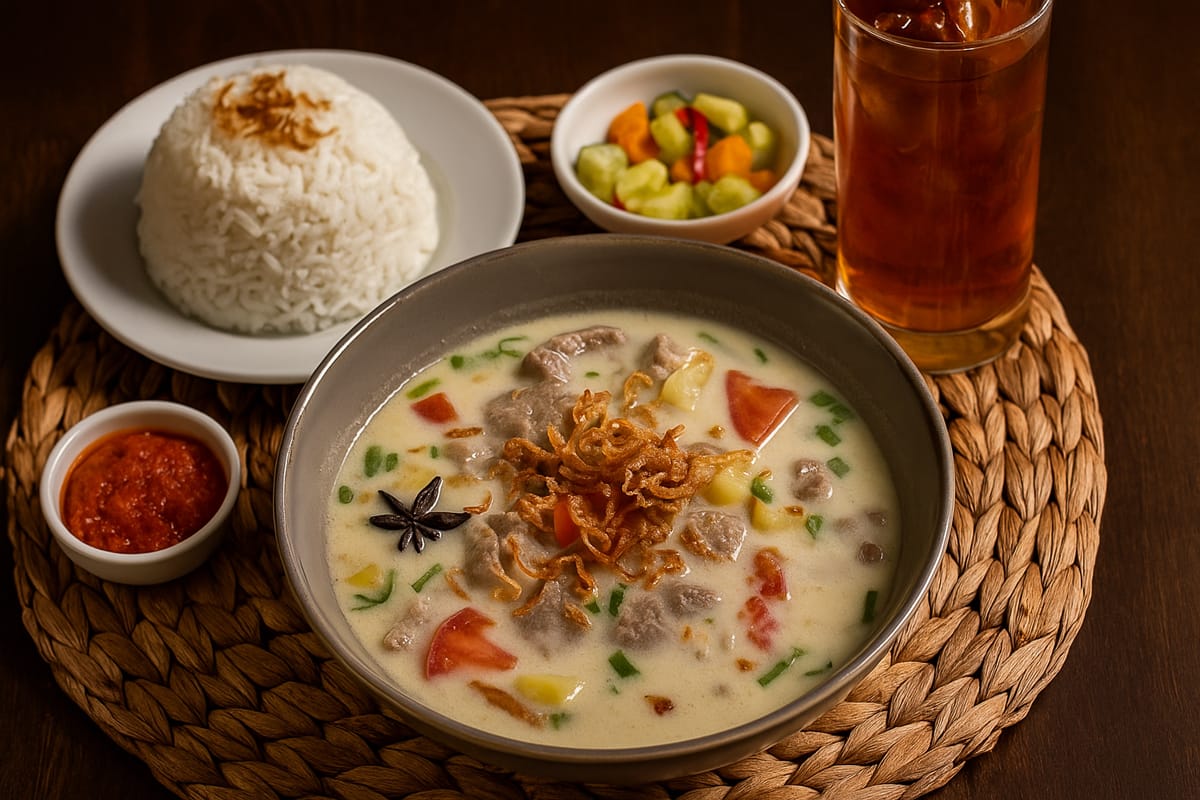
Soto Betawi (Jakarta Beef Soup with Coconut Milk and Milk)
Ingredients
Instruction
- Place beef brisket in a large pot with 2.5 liters of water.
- Bring to a boil, then discard the first water to remove impurities.
- Refill with fresh water (about 2.5 L) and simmer until the beef is tender, about 1 hour.
- Remove the beef, cut into 2×2 cm cubes, and reserve 2 liters of the beef stock for the soup.
- Add the pre-boiled babat (tripe) and paru (lung) to the pot with the beef cubes.
- Simmer gently over low heat.
- In a skillet, heat the cooking oil.
- Add the blended bumbu halus, along with cinnamon stick, cloves, lemongrass, galangal, daun salam, and daun jeruk.
- Sauté over medium heat until fragrant and the oil starts to separate (about 5–7 minutes).
- Transfer the sautéed spice mixture into the pot with beef stock.
- Add salt, pepper, nutmeg, and sugar. Stir well and bring to a gentle boil.
- Lower the heat to the minimum.
- Gradually pour in santan (coconut milk) and milk while stirring continuously.
- Simmer gently for 5–10 minutes until the broth turns creamy and aromatic.
- Avoid rapid boiling to prevent curdling.
- Ladle the hot soup into bowls.
- Top with beef, tripe, and lung pieces.
- Add fried potato cubes, tomatoes, green onions, and bawang goreng.
- Serve with emping, sambal, and lime wedges on the side.
Notes
- Coconut milk substitution: If santan (coconut milk) isn’t available, use canned coconut milk found in the Asian section of most supermarkets. Avoid “coconut cream” — it’s too thick.
- Evaporated milk: Gives a rich, creamy texture. If unavailable, use whole milk or half-and-half.
- Offal options: You can skip babat and paru for a simpler beef-only version, or replace them with mushrooms for a vegetarian twist.
- Spice level: Soto Betawi is not spicy by default. Serve with sambal or chili sauce on the side for adjustable heat.
- Serving suggestion: Serve with steamed white rice or warm bread rolls for a Western-friendly pairing.
- Fried shallots: You can find pre-fried shallots in Asian grocery stores, or make your own by frying thinly sliced shallots until golden.
A Taste of History: From Batavia to the World
“Soto Betawi” literally means “Jakarta-style soup.” But its story runs deeper than geography — it’s a culinary reflection of centuries of cultural exchange.
A Melting Pot of Cultures
According to historical accounts, soto was first brought to the Indonesian archipelago by Chinese immigrants in the 18th century. The Chinese dish cau do (literally “spiced offal soup”) evolved through contact with local ingredients and tastes. When Arab and Indian traders settled in Batavia (Jakarta), they added fragrant spices — cinnamon, cloves, nutmeg — and the use of beef and jeroan (offal).

Then came the Dutch colonial period. European influence introduced dairy, which explains why Soto Betawi sometimes blends both santan and milk. That mix of coconut and cow’s milk gives the soup its signature creamy depth — a taste both exotic and familiar.
The Birth of the Name
Though people had been selling versions of this soup since the early 20th century, the term Soto Betawi only appeared around the late 1970s. A Chinese-Indonesian vendor named Lie Boen Po in Kemanggisan was the first to label his stall “Soto Betawi.” The name stuck — and soon every Jakarta street had its own Soto Betawi Bang Udin or Soto Betawi H. Ma’ruf.
By 2016, Soto Betawi was officially recognized as part of Indonesia’s Intangible Cultural Heritage, confirming its place not only in Jakarta’s kitchens but in the national identity.
Cultural Context — The Indonesian Touch
Food in Indonesia isn’t just sustenance; it’s a mirror of society. Soto Betawi was once considered a luxurious dish — reserved for special occasions or the wealthy, because beef and coconut milk were expensive ingredients. Over time, democratization and economic growth turned it into an everyday comfort meal, available from humble street stalls to five-star hotel menus.
Today, it represents:
- Hospitality: Offering soto to guests means serving warmth and care.
- Diversity: Each version reflects the multicultural fabric of Jakarta — Chinese, Arab, Indian, and Dutch influences living in harmony.
- Tradition Meets Modernity: Once made only with fresh coconut milk, now also cooked with evaporated milk for a Western-friendly creaminess.
Flavor Philosophy — Why It Works
At its heart, Soto Betawi is a symphony of contrast and balance:
- The richness of beef and coconut milk meets the brightness of lime and tomato.
- Sweet spices like nutmeg and cinnamon are balanced by savory notes of garlic, shallots, and coriander.
- The silky broth complements the crunch of emping crackers and fried shallots.
What makes it stand out from other Indonesian soto?
- The use of coconut milk and/or milk, creating a thick, creamy soup instead of the usual clear or yellow broth.
- The inclusion of offal (babat, paru, torpedo) for depth of flavor and texture.
- The aroma of cinnamon and cloves, rarely found in other regional soto varieties.
In short, Soto Betawi is not just hearty — it’s luxurious, comforting, and complex, yet grounded in the simplicity of home cooking.
Why It’s Called Soto Betawi
“Betawi” refers to the native people of Jakarta — descendants of Malay, Chinese, Arab, and local ethnic groups who formed the city’s early population. When Lie Boen Po coined the name Soto Betawi, he didn’t just name a soup — he named an identity.

The dish soon became the culinary ambassador of Jakarta, much like Pad Thai represents Bangkok or Pho represents Hanoi.
How Indonesians Serve It
In Indonesia, Soto Betawi is served steaming hot in deep bowls, often accompanied by:
- Emping (melinjo crackers)
- Jeruk nipis (lime wedges)
- Sambal cabai rawit (fiery chili sauce)
- Acar mentimun (pickled cucumber)
- Steamed rice on the side
It’s a full meal rather than a starter — rich enough to satisfy on its own. In family homes, it’s often the centerpiece of celebrations, while in Jakarta’s busy streets, it’s a go-to lunch for office workers craving comfort.
What Makes It Different from Other Soto (and Is It the Same as Soto Tangkar?)
While both Soto Betawi and Soto Tangkar hail from Jakarta, they’re not identical.
- Soto Betawi uses coconut milk or milk for a creamy, rich broth.
- Soto Tangkar is its older cousin — it traditionally uses beef ribs (tangkar) and a clearer, spicier broth without milk.
Think of Soto Betawi as the “modernized” version, born from culinary innovation and city sophistication.
Can It Be Made Without Coconut Milk?
Absolutely. There are three recognized versions today:
- Soto Betawi Santan (coconut milk only) – the traditional one, rich and nutty.
- Soto Betawi Susu (milk only) – lighter, often found in modern cafés.
- Soto Betawi Santan-Susu (combination) – the best of both worlds, giving the perfect creamy consistency.
If you skip the coconut milk, the soup tastes lighter and less fragrant but still comforting. If you skip the milk, it’s more aromatic and authentically Indonesian. Using both gives that balanced creamy-sweet taste Western diners love.
Did You Know?
In 2025, the international food guide TasteAtlas ranked Soto Betawi as the second-best soup in the world, scoring 4.63 out of 5, right below Paraguay’s Vori-vori and just above Indonesia’s Rawon. This recognition highlights how Soto Betawi has transcended its Jakarta roots to become a global culinary treasure — a perfect blend of rich tradition, bold spices, and heartwarming comfort.

Tips for Making the Perfect Soto Betawi
Here’s how you can bring Jakarta’s warmth to your own kitchen:
Cooking Tips
- Simmer gently: To keep the broth smooth and creamy, don’t boil after adding milk or coconut milk.
- Use fresh aromatics: Lemongrass, galangal (lengkuas), and kaffir lime leaves (daun jeruk) are non-negotiable for that authentic tropical scent.
- Balance the flavor: Add a little sugar to round out the salt and spice — that’s the secret of Indonesian cooking.
- Don’t skip the topping: Bawang goreng (fried shallots) and emping add texture and flavor contrast.
Serving Tips
- Serve with steamed jasmine rice.
- For Western plating, pair it with warm baguette slices or flatbread.
- Add a side of lime wedges and chili sauce so guests can adjust heat to their liking.
Nutrition Notes
- A bowl of Soto Betawi (about 400–450 kcal) provides:
- Protein from beef
- Healthy fats from coconut milk
- Vitamins from tomato and lime
- For a lighter version:
- Use lean beef or chicken breast
- Replace half the coconut milk with milk or vegetable broth
- Skip offal for lower cholesterol
Fun Facts You’ll Love
- The creamy broth was originally a sign of wealth — only the upper class could afford beef and coconut milk in colonial Batavia.
- Some early versions used susu kuda (mare’s milk) before cow’s milk became common!
- Instant noodles in Indonesia now come in “Soto Betawi flavor” — proof that this once-aristocratic dish is now loved by everyone.
- Soto Betawi can be found today in Jakarta, Amsterdam, Tokyo, and even New York — wherever the Indonesian diaspora lives, the aroma follows.
Bringing It to Your Table
Cooking Soto Betawi at home is like taking a small journey to Jakarta — without leaving your kitchen. It’s an invitation to taste the story of a city, where coconut meets milk, East meets West, and tradition meets innovation.
So go ahead:
- Try making Soto Betawi this weekend.
- Share it with your friends and family.
- Add your own twist — maybe a splash of cream, maybe tofu instead of tripe.
Every bowl tells a story. What will yours say?