When people in the West hear the word onde-onde (pronounced ON-day ON-day), many assume it refers to klepon (pronounced KLEH-pon)—green sticky rice balls filled with liquid palm sugar and rolled in grated coconut. I once faced the same confusion. I came across a recipe titled “onde-onde” on an international food blog, only to realize it was actually the klepon I knew back home in Indonesia.
After digging deeper, I learned why. In Indonesia, onde-onde means sesame-coated balls filled with mung bean paste. Meanwhile, klepon refers to the green coconut-covered version. But in Malaysia and among overseas communities, klepon is often introduced as onde-onde. The name stuck because it’s easier to pronounce and became widely used by food bloggers and YouTubers abroad.

So, let’s set the record straight: in Indonesia, onde-onde is the golden sesame ball with mung bean filling—crispy, chewy, and soft all at once.
A Long Journey Through History
Although it feels quintessentially Indonesian today, onde-onde’s roots stretch far back to ancient China. It dates to the Zhou Dynasty (1045–256 BC), where it was known as Jian Dui (煎堆)—a fried glutinous rice ball stuffed with sweet red bean paste.
Legend has it that these sesame balls were originally made for stonemasons and carpenters working on imperial palaces, symbolizing safety and togetherness. The round shape stood for perfection, while the sesame seeds carried hopes of prosperity.

The snack became highly popular during the Tang Dynasty, even described by poet Wang Fanzhi as a delicacy of the Chang’an imperial court. Across China, it goes by many names: ma tuan, ma yuan, zhen dai, or zhi ma qiu (literally “sesame balls”).
In the 14th–15th centuries, Chinese merchants—including Admiral Zheng He’s fleet—brought onde-onde to the Indonesian archipelago. At first, they were filled with palm sugar. Over time, Indonesians transformed the recipe by using mung bean paste, adding a subtle savory note that perfectly matched the local palate.
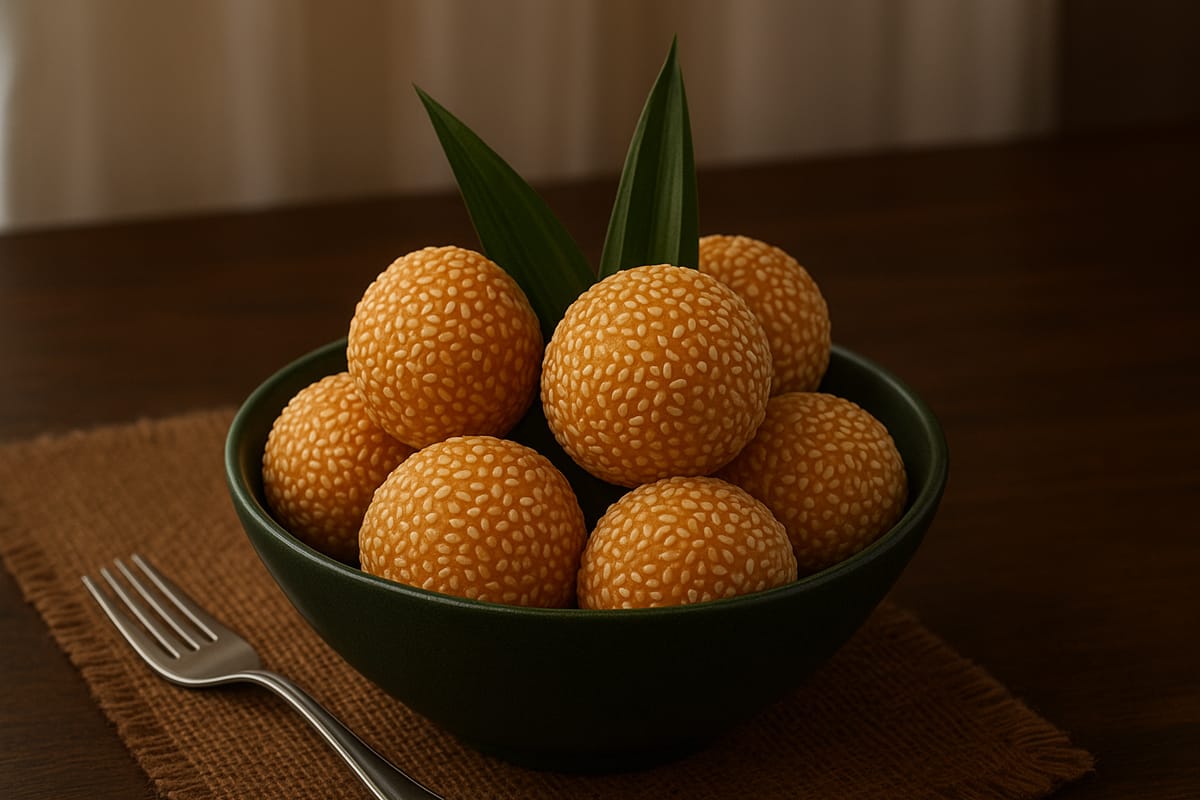
Onde-Onde: Indonesian Crispy Sesame Balls
Ingredients
Instruction
- Soak mung beans for at least 2 hours. Steam or boil until tender.
- Transfer to a pan, add sugar, pandan leaf (or vanilla), coconut milk, and salt.
- Cook over medium heat, stirring until thick and smooth, able to be shaped.
- Remove pandan leaf, let cool, then roll into small balls (about 25 pieces).
- In a small saucepan, bring water to a boil.
- Add tapioca flour, stir until it forms a sticky paste. Set aside.
- In a large bowl, dissolve sugar and salt in boiling water.
- Add glutinous rice flour, stir with a spatula until combined.
- Mix in the starter dough, knead until smooth and pliable.
- Divide into 25 equal portions.
- Flatten a dough ball, place one filling ball inside, and seal tightly.
- Roll into a smooth ball. Dip briefly in water, then coat evenly with sesame seeds.
- Heat a generous amount of oil over medium heat (around 320–340°F / 160–170°C).
- Fry in batches, stirring and gently pressing with a slotted spoon or spatula to keep the shape round.
- Cook until golden brown and crisp. Drain well.
Notes
- Glutinous rice flour (tepung ketan): Also called sweet rice flour. Common brands in the US include Mochiko. Do not substitute with regular rice flour, as it will not be sticky.
- Mung beans (kacang hijau kupas): Look for “hulled mung beans” at Asian or Indian grocery stores. They are yellow and split. If unavailable, you may use sweet red bean paste as a substitute.
- Pandan leaf (daun pandan): Used for aroma. In Western countries, you can skip it or use ½ tsp vanilla extract for a similar sweet fragrance.
- Coconut milk (santan kental): Use canned coconut milk. Shake well before use.
- Frying tips: Use enough oil so the balls float and move freely. Keep oil at medium heat; too hot will cause them to burst, too low will make them greasy.
- Make-ahead option: The mung bean filling can be prepared 1–2 days in advance and stored in the fridge.
Onde-Onde in Indonesian Culture
Today, this traditional sesame pastry is found everywhere—from traditional markets in Java and Bali to family gatherings in Sumatra. The city of Mojokerto is even nicknamed “The City of Onde-Onde.”
More than just a snack, these sweet rice balls carry deep symbolism:
- Round shape → unity and harmony.
- Sweetness → happiness and joy.
- Sesame seeds → abundance and prosperity.
It’s often served during celebrations, particularly Lunar New Year within Chinese-Indonesian communities, as a blessing of good fortune.
Sesame Balls Across Asia
Onde-onde’s cousins appear all across Asia, each with a twist:
- China → Jian Dui or Ma Tuan, often filled with red bean paste.
- Vietnam → Bánh Cam (south) and Bánh Rán (north), sometimes flavored with jasmine or even stuffed with savory minced meat.
- Philippines → called Butsi or Buchi.
- Malaysia → Kuih Bom or sesame balls, sometimes filled with sweet coconut.
This wide family tree shows how beloved this simple golden ball is across cultures.
Onde-Onde from Manado: A Different Twist
While Javanese onde-onde is fried and coated in sesame, in Manado (North Sulawesi) it takes a different form. Manado onde-onde is boiled, rolled in grated coconut instead of sesame, and filled with molten palm sugar. In taste and texture, it’s actually closer to klepon.

This is part of why foreigners often confuse the two—because the Manado-style onde-onde resembles klepon, while the Javanese version remains sesame-coated.
Why Western Palates Love Onde-Onde
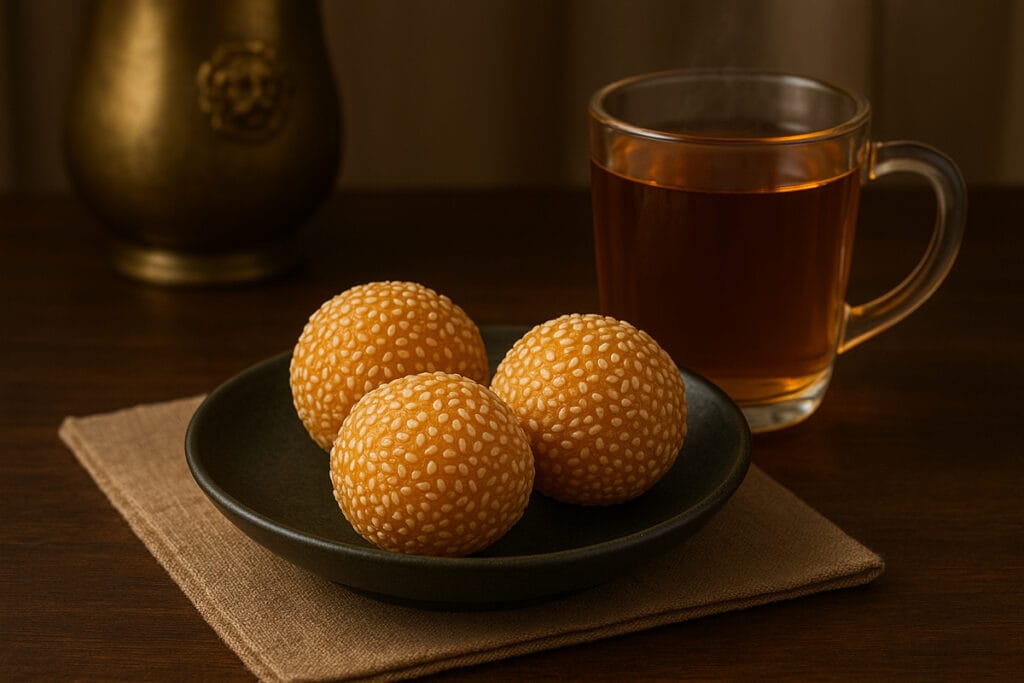
For Americans and Europeans, these sesame balls are surprisingly approachable:
- Familiar texture – Similar to Japanese mochi or sesame balls already popular in dim sum restaurants.
- Balanced flavor – The mung bean filling is gently sweet, balanced by the nuttiness of sesame and a hint of salt.
- Versatility – Works as a dessert, afternoon snack, or festive treat.
- Exotic yet comforting – It feels like an authentic Southeast Asian bite but not overwhelming for new eaters.
For Americans who enjoy donuts or sesame bagels, the sesame crust feels recognizable, while the chewy glutinous rice shell offers something uniquely fun.
Quick Tips for Foolproof Onde-Onde
Although simple-looking, this Indonesian sesame pastry can be tricky. Here’s how to avoid failure:
- Use a starter dough (biang) with tapioca starch and hot water for elasticity.
- Smooth filling makes rolling easier and prevents leaks.
- Dip in water before rolling in sesame for even coating.
- Fry over medium heat with enough oil to cover the balls—too hot, and they’ll burst.
- Keep them moving while frying to maintain a perfect round shape.
Serving Styles
In Indonesia
This snack is sold casually at wet markets, served on trays at family gatherings, or offered at traditional ceremonies. The aroma of toasted sesame and the chewy-sweet bite make it a timeless favorite.
For Western Dining
Onde-onde shines with a modern twist:
- Serve on minimalist plates with edible flowers as garnish.
- Pair with jasmine tea or espresso.
- Add to an Asian dessert platter alongside mochi, egg tarts, or pandan cake.
This elegant plating makes onde-onde a natural fit for cafés and fusion restaurants abroad.
The Benefits Behind the Flavor
This traditional dessert isn’t just tasty—it carries some nutritional perks:

- Mung beans → rich in plant protein, fiber, and B vitamins.
- Sesame seeds → packed with calcium, iron, and antioxidants.
- Glutinous rice → provides quick energy.
Of course, since they’re fried, moderation is key.
Onde-Onde vs. Klepon: Clearing the Name Game
The naming mix-up abroad is a fascinating example of food migration. In Indonesia, onde-onde ≠ klepon. But in Malaysia and international communities, klepon is often introduced as onde-onde. Food bloggers further spread this naming because “onde-onde” is easier to pronounce than klepon.
Personally, I don’t mind what name people use. What matters is that these little rice balls—whether sesame-coated or coconut-covered—bring joy and curiosity to more people worldwide.
Wrap Up
This beloved sesame ball is far more than a sesame ball. It’s a bridge between ancient China and modern Indonesia, between street markets and fine dining, between symbolism and indulgence.
Whether you call it onde-onde, jian dui, bánh cam, or butsi, it remains a symbol of sweetness, unity, and prosperity. And if you ever find yourself confused between onde-onde and klepon—take it as part of Asia’s rich culinary tapestry worth celebrating.