“A Tangy, Spicy, and Refreshing Taste of Indonesia’s Cultural Fusion”
A Personal Encounter with a Peculiar Salad
If you’re not from Indonesia, your first glance at Asinan Betawi might make you pause. Honestly, even for me—someone who grew up in Indonesia—it looked strange the first time I saw it.
“Raw vegetables with broth?” I thought. I was used to asinan buah (fruit pickles), not this version filled with tofu, lettuce, and cabbage swimming in a peanut-based sauce.
But then I tried it. The cool crunch of fresh vegetables mixed with a thin, tangy peanut dressing—spicy, sweet, and sour all at once—completely changed my mind. It felt familiar, like a Western salad, but also excitingly foreign.
And here’s a tip: Asinan Betawi tastes best chilled. Let it rest in the fridge for a couple of hours. That’s when the flavors really come alive—fresh, bold, and irresistibly refreshing.

Asinan Jakarta (Traditional Betawi Peanut Salad)
Ingredients
Instruction
- Prepare the IngredientsWash and cut all vegetables as listed. Blanch the bean sprouts briefly in boiling water, then cool. Steam or fry the tofu and cut into bite-sized cubes. Set aside the crackers for serving.
- Make the Peanut PasteBlend roasted peanuts, red chili peppers, bird’s eye chilies, garlic, and 1 cup of water until smooth. Reserve a few tablespoons of whole roasted peanuts for garnish.
- Cook the Asinan BrothIn a medium saucepan, pour in the peanut paste. Add dried shrimp powder (ebi), salt, sugar, tamarind water, vinegar, palm sugar, and 2 cups of water.Simmer over medium heat, stirring constantly until the sugar dissolves and the mixture boils gently.Taste and adjust: it should be sweet, tangy, spicy, and slightly salty.If it’s too thick, add more water until it reaches a thin, pourable consistency.Remove from heat and let cool completely — the broth is served cold or at room temperature, never hot.
- Assemble the SaladIn serving bowls, layer lettuce, cabbage, carrots, cucumber, bean sprouts, and tofu cubes.Pour the cooled peanut-tamarind broth generously over the vegetables until lightly submerged.Top with roasted peanuts and crushed noodle crackers.Serve immediately with pink crackers on the side for an authentic Jakarta touch.
Notes
- Ebi (dried shrimp powder): This gives umami depth. You can substitute with a dash of fish sauce or miso paste for similar savory flavor. Omit for a vegan version.
- Tamarind water (air asam jawa): Widely available in Asian or Indian stores. Substitute with lime juice mixed with a touch of brown sugar if unavailable.
- Palm sugar (gula merah): Can be replaced with dark brown sugar or coconut sugar.
- Kerupuk mie / kerupuk pink: Use crispy noodle snacks or shrimp chips as an easy Western substitute.
- Serving tip: Asinan is meant to be eaten cold, like a refreshing summer salad. Chill the broth for 1–2 hours before pouring it over the vegetables.
Flavor Profile
This dish balances the five essential tastes:- Sweetness from palm sugar,
- Tang from tamarind and vinegar,
- Heat from chilies,
- Savory from peanuts and shrimp powder,
- Freshness from raw vegetables.
What Exactly Is Asinan?
In Indonesian, asinan comes from the word asin, meaning “salty” or “preserved.” The term refers to any dish made by soaking vegetables or fruits in a brine of salt or vinegar—similar to pickling.
So while it may look like a salad, asinan is technically a form of preserved vegetable dish. There are many types across Indonesia, but the two most famous are Asinan Betawi (from Jakarta) and Asinan Bogor (from the nearby highland city of Bogor).
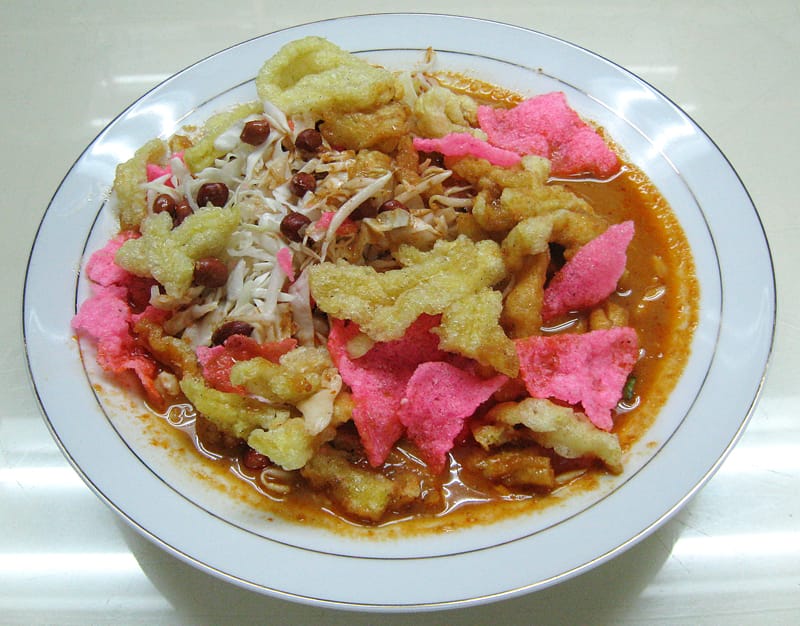
Where Asinan Bogor often focuses on fruits and a bright red chili dressing, Asinan Betawi celebrates vegetables—a medley of lettuce, cabbage, bean sprouts, cucumber, carrots, and tofu—drenched in a thin, spicy peanut and tamarind sauce.
It’s not quite a salad, not exactly a pickle, and not a soup either. It sits beautifully in between—a refreshing hybrid born from Jakarta’s multicultural roots.

Origins: From Colonial Batavia to Modern Jakarta
The story of Asinan Betawi stretches back to the 17th century, during the Dutch colonial era, when Jakarta was still known as Batavia.
The Betawi people—the original inhabitants of the city—were a mix of various ethnic groups: Indonesian natives, Chinese traders, Arab merchants, and Dutch settlers. This melting pot gave birth to a unique cuisine that reflected all these influences.
Historical records suggest the word asinan might even have come from the Dutch term aijnen, meaning “sour.” The technique of preserving vegetables in salt or vinegar likely arrived with Chinese immigrants, who introduced pickling and the use of dried shrimp (ebi). The Arabs brought their own tradition of fermented vegetables like sawi asin (pickled mustard greens). And Dutch colonial cooks encouraged a milder, tangier profile to suit European palates.
What emerged was a dish that mirrored Jakarta itself: a cultural fusion in a bowl—Chinese techniques, Indonesian spices, and European influence on taste and balance.
Evolution of the Recipe
In its earliest form, Asinan Betawi was simple: sliced cucumber and pineapple tossed with a thin peanut sauce.
Over time, locals began adding more textures and flavors—crisp cabbage, crunchy bean sprouts, soft tofu, and salty sawi asin—each layer adding character. The finishing touch came from kerupuk mie (noodle crackers) and kerupuk pink (bright pink tapioca crackers), likely inspired by Chinese-style crispy toppings.
Today, it’s hard to imagine Jakarta’s food scene without Asinan Betawi.
Once a humble street food sold from pushcarts and traditional markets, it has become a beloved symbol of the city—served everywhere from roadside stalls to heritage restaurants.
What’s in a Name: Betawi or Jakarta?
Both names are correct—but they carry different nuances.
- Asinan Betawi emphasizes cultural identity. “Betawi” refers to the native ethnic group of Jakarta, the city’s original inhabitants. Calling it Asinan Betawi honors its roots as part of Betawi heritage cuisine.
- Asinan Jakarta, on the other hand, is more modern and accessible. It’s easier for global audiences to recognize and associate with Indonesia’s capital city.
So for an international audience, the best compromise is:
Jakarta Street Peanut Salad (Asinan Betawi) — authentic yet easy to understand.
Flavor Philosophy — Why It Works
At its heart, Asinan Betawi is all about balance. Indonesians have long believed that the perfect meal combines the five essential tastes—sweet, sour, salty, bitter, and spicy—in harmony.
The sweet notes come from palm sugar; the sour kick from tamarind and vinegar; saltiness from peanuts and shrimp powder; spice from chilies; and freshness from crisp vegetables.
Together, these elements create a symphony that awakens your senses.
Unlike Western salads, which rely on creamy dressings or olive oil, Asinan Betawi uses a light, watery peanut sauce—not thick like satay or gado-gado, but almost like a spicy-tamarind broth. It coats rather than smothers, allowing the vegetables’ freshness to shine through.
And the final touch? Temperature.
Asinan Betawi is served cold, making it the perfect tropical counterpart to summer salads in the West.

Cultural Context — The Indonesian Touch
For the Betawi people, Asinan isn’t just food—it’s a social experience.
It’s what you share during gatherings, when friends stop by unannounced, or at family celebrations. In old Jakarta neighborhoods, it was common to see a vendor pushing a wooden cart, the sound of his ladle tapping against a tin bowl as he served portions to customers on the street.
It’s a dish that brings people together—light, communal, joyful.
Many locals even call it “the food of happiness” (makanan kegembiraan), because of its vibrant color, refreshing taste, and the nostalgia it evokes.
In many ways, Asinan Betawi reflects Jakarta itself: complex, mixed, colorful, and constantly evolving.
Why “Pickled”? The Art of Preservation
Indonesia’s hot, humid climate encouraged people to find ways to preserve food naturally.
Before refrigeration, soaking fruits or vegetables in saltwater or vinegar was a clever way to extend shelf life—hence the tradition of asinan.
In Asinan Betawi, this heritage of preservation meets creativity: the ingredients are not heavily fermented like kimchi, but lightly “cured” in an acidic broth that brightens rather than overwhelms.
It’s this fine balance that makes Asinan Betawi so distinct among Southeast Asian dishes.
Nutrition and Health — A Fresh, Feel-Good Dish
One reason Asinan Betawi endures is because it’s light yet nutrient-dense.
It’s packed with fiber, vitamins, and antioxidants from raw vegetables—vitamin C from cabbage, vitamin K from bean sprouts, vitamin B3 from lettuce, and vitamin E from peanuts.
The tamarind and vinegar add natural probiotics, supporting digestion, while the raw veggies help protect stomach acid balance.
And because it’s served cold, it’s incredibly hydrating—perfect for summer weather or post-workout recovery.
A quick note for Western eaters: because of the acidity and spice, it’s best to enjoy Asinan Betawi in moderation and not on an empty stomach.
Drink plenty of water afterward to balance the tanginess—just as locals do in Jakarta.
Asinan Betawi vs. Asinan Bogor — Cousins, Not Twins
While both dishes share the word asinan, they highlight different personalities:
| Aspect | Asinan Betawi (Jakarta) | Asinan Bogor |
|---|---|---|
| Main ingredients | Vegetables (lettuce, cabbage, tofu) | Fruits (pineapple, mango, papaya) |
| Sauce | Peanut-tamarind dressing | Sweet-sour chili brine |
| Texture | Crunchy and nutty | Juicy and spicy |
| Flavor base | Tangy, savory, slightly creamy | Bright, fruity, and sweet-hot |
| Cultural tone | Street food of the capital | Refreshing mountain-town specialty |
Both, however, share one core principle: balance between freshness and acidity, a hallmark of Indonesian taste philosophy.

How Indonesians Enjoy It
Traditionally, Asinan Betawi is served in a bowl with vegetables, tofu, and sawi asin layered together, then drenched with the tangy peanut broth.
Crushed noodle crackers (kerupuk mie) and pink tapioca chips add crunch.
Some people even drizzle extra palm sugar syrup on top for contrast.
Locals eat it in the afternoon, chilled, often paired with sweet iced tea—an ideal way to cool down after the heat of Jakarta’s bustling streets.
A Culinary Philosophy in a Bowl
To Indonesians, Asinan Betawi is more than just a salad.
It embodies harmony: of cultures, of flavors, of opposites.
Raw and cooked, spicy and cool, native and foreign—it captures the essence of Jakarta’s open, ever-evolving spirit.
It’s also a reminder that food doesn’t have to be complicated to be meaningful. Sometimes, all it takes is a handful of fresh vegetables, a splash of tamarind, and the courage to mix traditions together.
For Western Readers — Tips and Fun Facts
- Can’t find tamarind? Substitute with lime juice and a hint of brown sugar.
- Skip the dried shrimp for a vegan version—it’s still delicious.
- Chill it before serving; this isn’t a warm dish.
- Pair it with iced tea, coconut water, or even a crisp white wine for a refreshing twist.
Fun fact: Asinan Betawi is considered a “living heritage food.” Every year, it’s celebrated in Jakarta’s culinary festivals as a symbol of multicultural harmony.
Final Thoughts — Try It Yourself
If you love dishes like Thai peanut salad or Vietnamese goi, you’ll adore Asinan Betawi.
It’s easy to make, endlessly refreshing, and tells a story with every bite—a story of how Indonesia’s capital city learned to turn diversity into flavor.
So go ahead: try making it at home, share it with friends, and tell them you’ve discovered Jakarta in a bowl.
And when you do, you won’t just be eating a salad—you’ll be tasting centuries of culture, creativity, and joy.