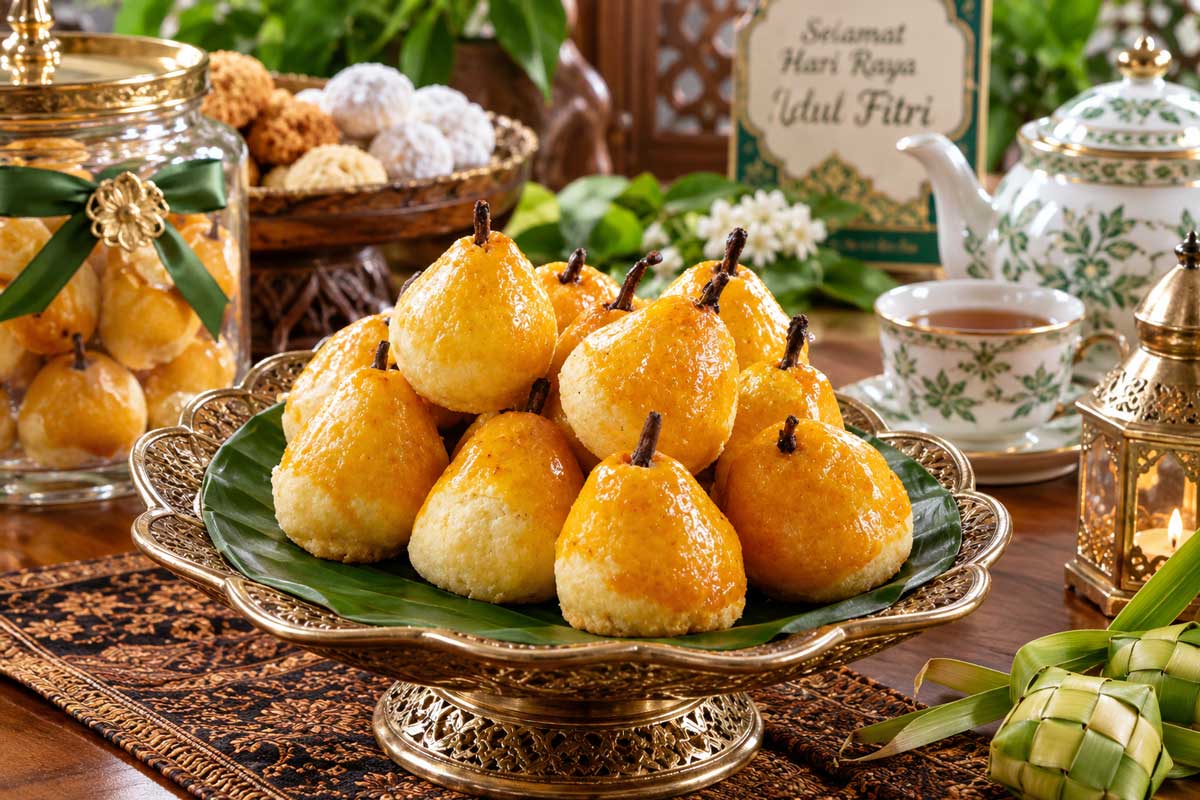
- The Indonesian Nastar is the undisputed king of festive baking, essential for Eid al-Fitr celebrations.
- Avoid the 'Nastar Retak' (cracked) disaster by ensuring your pineapple jam is cooked until completely dry and sticky.
- Use low-protein flour and European-style butter to achieve the signature melt-in-mouth shortcrust texture.
- The Indonesian Nastar carries deep cultural meaning, symbolizing fortune and prosperity in both Islamic and Chinese-Indonesian traditions.
Discover the secret to the perfect Indonesian Nastar, the ultimate Eid al-Fitr cookies that define the festive season. This guide ensures your pineapple tart recipe yields a flawless melt-in-mouth shortcrust every time.
In Indonesia, as the holy month of Ramadan draws to a close, every Muslim household begins a beautiful and bustling tradition of preparing for Eid al-Fitr (Lebaran). The absolute core of this celebration is silaturahmi—the practice of visiting the homes of extended family, friends, and neighbors to seek forgiveness and reconnect. To welcome these guests, coffee tables across the archipelago are proudly adorned with jars of festive cookies. At the center of it all sits the undisputed king of Indonesian baking: Indonesian Nastar, often paired with other festive treats.
Like many families, there was a year we decided to take a leap and bake our own Eid treats instead of buying them. Nastar was naturally our first choice. Reading through the recipe book, it seemed deceptively simple: standard baking ingredients and straightforward instructions. We meticulously measured the flour and butter, cooked the pineapple jam, carefully stuffed the dough, and shaped them beautifully like little rose apples (jambu), complete with a clove on top. (Kastengel Recipe: Irresistible Indonesian Cheese Cookies – Indonesian Nastar).
But baking, as we quickly learned, is an unforgiving science. When we pulled the tray out of the oven, our beautiful pastries had expanded, cracked down the middle, and become incredibly brittle. Instead of the elegant Nastar Jambu we had envisioned, we had accidentally created what I jokingly named Nastar Retak-Retak (Cracked Nastar). As hilarious as it was, we couldn’t possibly serve crumbling cookies to our Eid guests, and we inevitably ended up rushing out to buy ready-made jars from the local bakery anyway (Indonesian Nastar). [Dutch East Indies – Wikipedia]
That memorable baking failure taught me exactly what not to do. Today, I am sharing not just a perfected, authentic recipe for Nastar, but also the crucial secrets to ensuring your tarts come out flawlessly smooth, buttery, and intact (Indonesian Nastar).

The History and Meaning Behind Nastar
The story of Nastar is a fascinating reflection of Indonesia’s colonial history. The pastry traces its roots back to the Dutch East Indies era. Dutch colonizers longed for the pies and tarts of their European homeland, which were typically filled with apples or berries. However, those fruits did not thrive in the tropical Indonesian climate. Adapting to local agriculture, they substituted apples with abundant, locally grown pineapples (Indonesian Nastar).
The name itself is a portmanteau born from the Dutch language: ananas (pineapple) and taart (tart or pie), which the locals seamlessly blended into the word “Nastar.” According to Indonesian culinary historians, this adaptation is a prime example of how colonial European baking techniques merged with tropical ingredients to create an entirely new, enduring culinary tradition (Indonesian Nastar).
Beyond its Dutch origins, Nastar carries profound cultural philosophy, particularly within the Chinese-Indonesian community. In the Hokkien dialect, pineapple is called ong lai, which phonetically translates to “fortune comes.” Serving Nastar during the Lunar New Year (Imlek) symbolizes the ushering in of prosperity, wealth, and sweetness. Over the decades, this philosophy of sharing joy and abundance transcended ethnic and religious boundaries, making Nastar a mandatory staple for all Indonesian celebrations.
Authentic Indonesian Nastar (Pineapple Tarts)
Ingredients
Instruction
- Place the grated pineapple (along with its natural juices) and the cinnamon stick into a wide, heavy-bottomed skillet or wok over medium heat.
- Cook, stirring occasionally, until the liquid has almost entirely evaporated. This requires patience; rushing it on high heat will burn the fruit.
- Once the mixture is dry, lower the heat and add the granulated sugar.
- Continue to cook, stirring constantly, until the jam turns a dark golden-brown, caramelizes, and thickens into a sticky paste that holds its shape.
- Remove from heat, discard the cinnamon stick, and let it cool completely. (Pro-tip: Make the jam a day ahead and store it in the fridge. Cold jam is much easier to roll into balls for filling.)
- In a large mixing bowl, combine the room-temperature butter and sifted powdered sugar. Using a mixer on a low speed, beat them together just until pale and soft (about 1–2 minutes). Do not overmix.
- Add the egg yolk and beat briefly just until incorporated.
- Gradually fold in the sifted cake flour and cornstarch in three batches, using a spatula. Mix gently until a soft, pliable dough forms.
- Preheat your oven to 150°C (300°F). Line a large baking tray with parchment paper.
- Take about one teaspoon of dough and flatten it into a small disc in the palm of your hand.
- Place a small, marble-sized portion of the cooled pineapple jam in the center.
- Carefully fold the dough over the jam, sealing it completely so no jam is exposed.
- To create the traditional jambu (rose apple) shape, gently pinch the top of the ball slightly so it tapers upward, resembling a small bell.
- Gently press one whole clove (stem side down) into the top center of the tapered dough.
- Arrange the shaped tarts on the prepared baking tray, leaving about an inch of space between them.
- Bake in the preheated oven at 150°C (300°F) for 10 minutes. The dough should look pale but set.
- Remove the tray from the oven and let the cookies cool down completely (at least 15–20 minutes).
- Once the cookies are cool, use a soft pastry brush to gently apply the beaten egg yolk over the surface of each tart. Let the first coat dry for 5 minutes, then apply a second coat for a glossy finish.
- Immediately after brushing the final coat, sprinkle a small pinch of grated cheese on top of each tart, nestling it slightly around the clove.
- Return the tray to the oven and bake for another 15 to 20 minutes, or until the glaze turns a beautiful, rich golden brown.
- Remove from the oven. The cookies will be very fragile while hot. Let them cool completely on the baking tray before transferring them to an airtight container.
Notes
- Moisture is the Enemy: The most common reason Nastar cracks in the oven is that the pineapple jam was not cooked until it was completely dry. Excess moisture in the jam will turn to steam in the oven, bursting through your delicate pastry crust.
- Working in Batches: If you live in a hot climate, keep half of your dough in the refrigerator while you shape the other half. Warm dough is difficult to work with and yields a greasy finish.
- Storage: Properly baked and cooled Nastar can be stored in an airtight container at room temperature for up to 3–4 weeks. Keep them away from direct sunlight.
- Make-Ahead Jam: Authentic pineapple jam takes a long time to reduce properly. It is highly recommended to make the jam 1 to 3 days before you plan to bake the cookies. It stores perfectly in the refrigerator.
The Taste Profile: What to Expect
If you have never tasted Nastar, prepare your palate for a brilliant study in contrasts. The exterior is incredibly rich, milky, and buttery—it should literally melt in your mouth the moment you bite into it. A touch of cheese in the dough provides a subtle, savory undercurrent that prevents the cookie from becoming cloying.
Inside, the pineapple jam is nothing like the bright, runny jelly found in Western supermarkets. Authentic Nastar jam is slow-cooked until it reduces into a thick, sticky, caramelized paste with deep amber hues. The tartness of the pineapple cuts through the rich butter crust, while the cinnamon and the clove garnish release warm, woody aromas that linger on the palate.
Global Cousins: Similar Foods Around the World
Nastar shares a culinary lineage with several global pastries. Its closest relative is the Taiwanese Pineapple Cake (Feng Li Su). While both feature a pineapple filling, the Taiwanese version is typically formed into dense, square blocks, and the crust leans more toward a firm, crumbly shortbread.
You might also find conceptual similarities with Austrian Linzer Tarts or Western Thumbprint Cookies filled with jam. However, these European counterparts usually feature the jam exposed on top of the cookie, whereas Nastar entirely encases the filling, creating a surprise burst of fruit. In Latin America, Empanadas de Piña share the concept of pastry wrapped around pineapple, but they are generally much larger and utilize a flakier, empanada-style dough.

Sourcing Ingredients: International Substitutions
For international readers shopping at Western supermarkets, finding exact Indonesian brands can be tricky. Here is how you can easily adapt the recipe using locally available ingredients:
- Mentega (Butter): In Indonesia, premium Nastar is baked using canned European butter, specifically the Dutch brand Wijsman. To replicate this rich flavor, opt for high-fat, European-style cultured butter like Kerrygold or Plugrá.
- Gula Halus (Powdered Sugar): Standard confectioners’ or icing sugar works perfectly.
- Tepung Terigu (Wheat Flour): Indonesian recipes call for low-protein flour to achieve that melt-in-the-mouth texture. Use cake flour or pastry flour. If you only have all-purpose flour, remove two tablespoons of flour from every cup and replace it with two tablespoons of cornstarch.
- Maizena (Cornstarch): Readily available globally; this is the secret to the delicate, crumbly texture.
- Nanas (Pineapple): Fresh pineapples are absolutely mandatory. If forced to use canned pineapple, buy crushed pineapple in juice (not syrup), drain it aggressively, and reduce the added sugar in the recipe.
- Keju (Cheese): Indonesian baking frequently utilizes firm, processed cheddar. You can substitute this with any mild, firm cheddar or standard Edam cheese from your local deli.
Crucial Warnings: How to Avoid “Nastar Retak” (Cracked Tarts)
To ensure you don’t end up with Nastar Retak-Retak like my family did on our first attempt, pay close attention to these common pitfalls:
- Wet Pineapple Jam: This is the number one reason Nastar cracks. If the jam isn’t cooked until it is completely sticky and dry, the residual moisture will turn into steam inside the oven. That steam will burst through your delicate pastry crust, causing deep cracks.
- Over-whipping the Butter: Nastar is a shortcrust pastry (kue kering), not a sponge cake. If you whip the butter and sugar for too long, you will incorporate too much air into the dough. The cookies will puff up in the oven and then aggressively deflate and crack. Mix the butter just until combined (1 to 2 minutes maximum).
- Glazing Too Early: Never brush the egg wash onto raw or hot dough. As the dough naturally expands during the first bake, a raw egg glaze will dry out and crack along with the expansion. Always do the first bake, let the cookies cool completely, and then apply the glaze before the final bake.
- Warm Hands: Shaping the dough too slowly with warm hands will melt the butter into the flour before it hits the oven, resulting in a greasy dough that crumbles easily. If your kitchen is warm, keep half the dough in the fridge while you work.
Nutritional Overview, Benefits, and Risks
- The Good: Pineapples are naturally rich in Vitamin C, manganese, and bromelain—an enzyme known to aid digestion and reduce inflammation. The cloves and cinnamon also provide antioxidant properties.
- The Risks: Nastar is a festive indulgence. It is dense in calories, simple carbohydrates, and saturated fats due to the high butter and sugar content. Overconsumption can lead to spikes in blood sugar and cholesterol. It is best enjoyed in moderation, particularly for individuals managing diabetes or cardiovascular health.
How to Serve Nastar
In Indonesia, Nastar serves as a decorative centerpiece. The cooled pastries are meticulously arranged in pristine, airtight glass or acrylic jars (toples). When guests arrive, the jars are opened and placed on the table alongside a pot of hot, unsweetened jasmine tea or robust black tea. The bitterness of the tea perfectly cleanses the palate between bites of the rich, sweet tarts.
Estimated Cost to Make
Baking a batch of Nastar at home is incredibly cost-effective. Depending on your location and the quality of butter you choose, a full batch yielding 800 grams (approximately 60–80 pieces) will cost roughly $8.00 to $15.00 USD / €7.50 to €14.00 EUR.