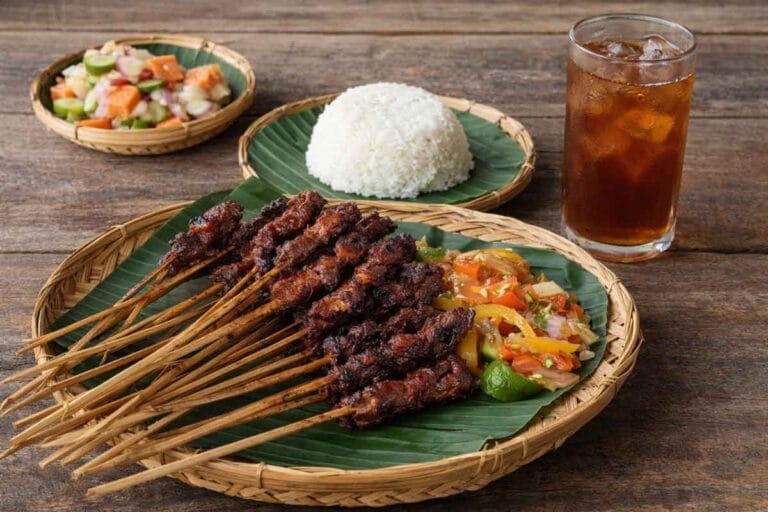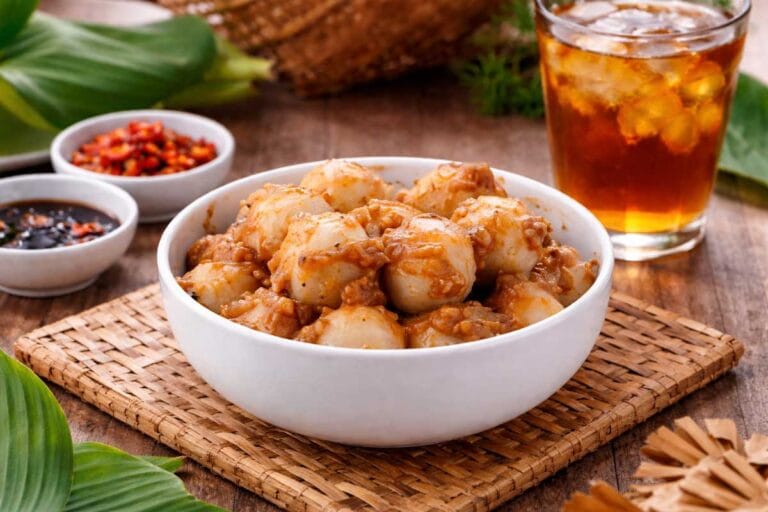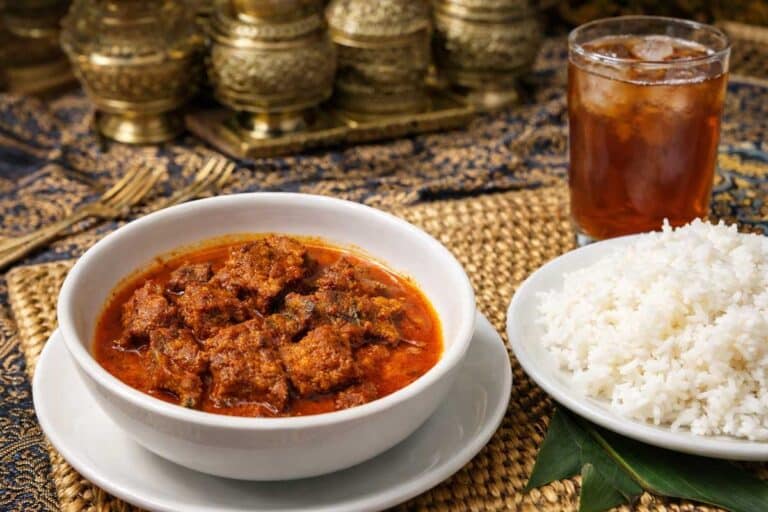
When people hear the word satay, they often imagine skewered meat grilled over charcoal and coated in a rich sauce. Satai Bungkus Bangka tells a very different story. Despite its name, this traditional dish from Bangka Island is not skewered, not grilled, and not cooked over fire at all. Instead, it is gently steamed, wrapped in banana leaves, and built around the delicate flavor of finely minced mackerel.
Quiet, comforting, and deeply rooted in home kitchens, satai bungkus represents a lesser-known side of Indonesian cuisine—one shaped by the sea, family gatherings, and Malay coastal traditions.
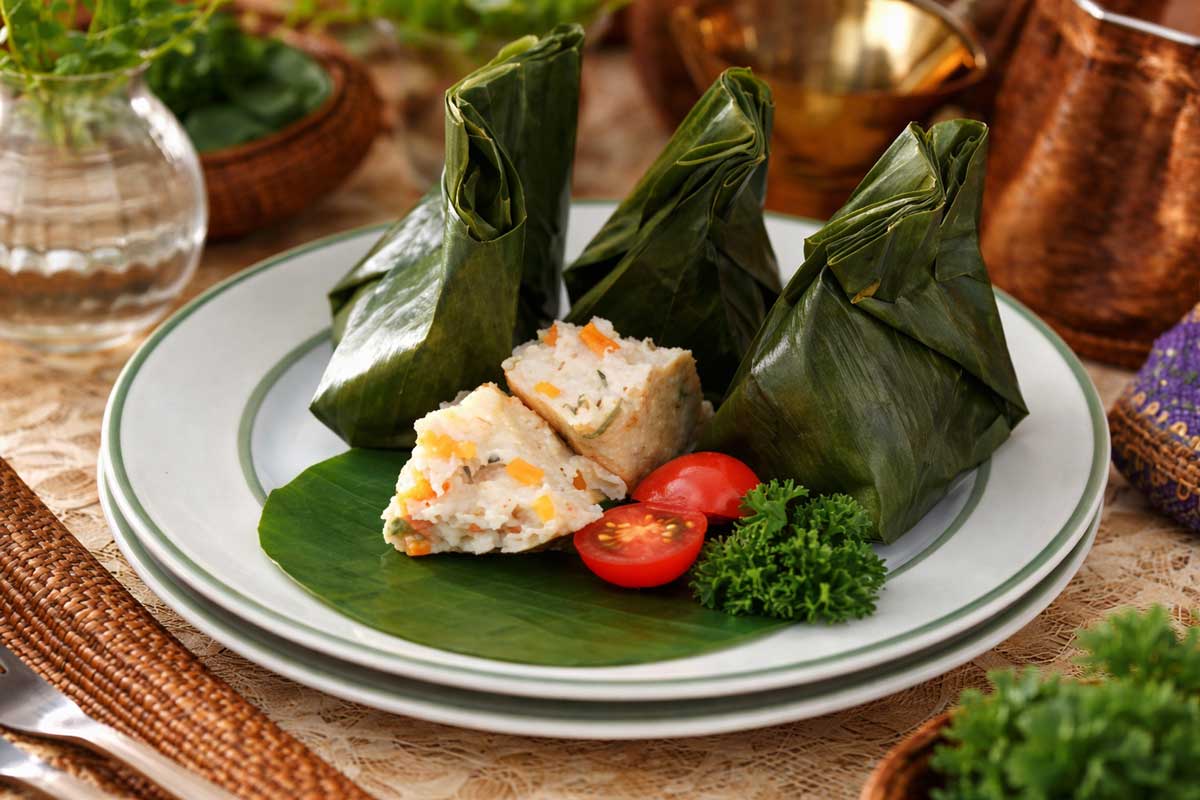
Satai Bungkus Bangka (Steamed Wrapped Mackerel Satay)
Ingredients
Instruction
- Prepare the banana leavesBriefly pass the banana leaves over an open flame or hot pan until softened. This prevents tearing and releases aroma. Set aside.
- Mix the fish baseIn a large bowl, combine the minced Spanish mackerel (ikan tenggiri), shallots (bawang merah), and scallions (daun bawang). Mix gently until evenly distributed.
- Add vegetablesFold in the finely diced carrot (wortel) and jicama (bengkuang). Ensure the pieces are very small so the mixture stays cohesive.
- Season and enrichAdd the egg (telur), coconut milk (santan), salt, and black pepper. Mix until the batter is soft, moist, and spoonable—but not runny.
- WrapSpoon the mixture onto the center of each banana leaf. Shape into a small log or compact parcel, then fold tightly and secure with toothpicks if needed.
- SteamPlace the wrapped parcels in a steamer basket. Steam over medium heat for 25 minutes, or until fully cooked and firm to the touch.
- ServeLet rest for a few minutes before unwrapping. Serve warm, traditionally without sauce or with a light chili condiment on the side.
Notes
-
Fish substitution:
If Spanish mackerel (ikan tenggiri) is unavailable, kingfish, king mackerel, or even firm Atlantic mackerel works well. Avoid oily canned mackerel. -
Jicama substitute:
Jicama (bengkuang) can be replaced with:- Water chestnuts (very finely diced), or
- Asian pear (for a slightly sweeter profile)
-
Banana leaf alternative:
Banana leaves are available frozen in Asian or Latin markets. If unavailable, parchment paper can be used—but note that aroma will be milder. -
Texture tip:
The mixture should be soft but hold its shape. If it feels too loose, add 1–2 tablespoons of breadcrumbs or rice flour—this is optional and non-traditional but helpful in Western kitchens. -
Serving suggestion:
Serve with steamed rice and a simple chili sambal or lemon-chili sauce. The dish is intentionally mild and relies on the natural flavor of the fish.
Where Is Bangka, and Why Does It Matter?
Bangka Island lies off the eastern coast of Sumatra, facing the Karimata Strait, and forms part of Indonesia’s Bangka Belitung Islands province. For centuries, Bangka has been a maritime crossroads—connected by sea routes to Sumatra, Kalimantan, and the wider Malay world.
This geography defines its food culture. Seafood is central, and Spanish mackerel (ikan tenggiri) is especially prized for its firm flesh, clean taste, and versatility. Many of Bangka’s most iconic dishes—from crackers to steamed fish preparations—are built around this single ingredient.
Satai bungkus belongs firmly to this coastal lineage.
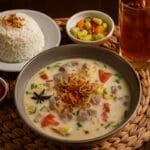
A Close Relative of Pempek—But with Its Own Identity
If satai bungkus feels familiar, that’s no coincidence. Bangka shares cultural and geographic proximity with Palembang, the birthplace of pempek, another famous mackerel-based dish. Both cuisines rely on finely minced fish and simple seasoning, shaped by similar river-and-sea environments.
The difference lies in intention and technique:
- Pempek is usually boiled or fried, relies heavily on starch, and is inseparable from its tangy cuko sauce.
- Satai bungkus is lightly bound, steamed in banana leaves, and designed to highlight softness, moisture, and balance rather than chew or crispness.
Think of satai bungkus as pempek’s quieter cousin—less commercial, more intimate, and firmly rooted in home cooking.
Why Is It Called “Satay” If It Isn’t Skewered?
Despite its name, Satai Bungkus Bangka is not prepared on skewers and is never grilled. The use of the word satay here does not indicate cooking technique, but rather reflects local naming tradition passed down through oral culinary heritage.
In many Indonesian food cultures, especially those rooted in home cooking, dish names do not always evolve alongside changes in preparation. In the case of satai bungkus, the name has been preserved through generations, even as the method—steaming fish wrapped in banana leaves—remains distinct from what is commonly understood as satay elsewhere in Indonesia.
Rather than redefining satay itself, satai bungkus stands as an example of how culinary identity can be shaped by memory, familiarity, and local usage, not strict technical classification.
Light Seasoning, Tender Texture, and Comforting Flavor
This home-style version of Satai Bungkus Bangka, as reflected in the recipe, is defined by a gentle, clean, and non-aggressive flavor profile. Rather than relying on heavy spices, the dish highlights balance and restraint—allowing the natural taste of mackerel to remain front and center.
The seasoning is intentionally simple:

- shallots and scallions provide a mild, aromatic base,
- salt and black pepper maintain balance without overpowering,
- coconut milk and egg contribute moisture and structure,
- while carrot and jicama add subtle natural sweetness and a light, pleasant texture.
There is no chili mixed into the fish batter. Heat is entirely optional and introduced at the table. In addition to a simple chili sambal, satai bungkus is also often enjoyed with cuko, the iconic sweet-and-sour sauce from Sumatra. Its bright acidity creates a refreshing contrast to the soft, savory fish, enhancing the dish without masking its original character.
The result is a dish that feels genuinely comforting, approachable for all ages, and easy on the palate.
How Satai Bungkus Is Served in Indonesia
In Bangka, satai bungkus is rarely a standalone dish. It is commonly served:
- at family gatherings,
- during community celebrations,
- or as part of a shared meal at home.
The parcels are opened while still warm, releasing the aroma of banana leaves, and enjoyed with steamed rice and optional condiments. Presentation is modest—because the emphasis is on warmth, familiarity, and togetherness, not spectacle.
Can You Make It Outside Indonesia? Absolutely.
One of the strengths of satai bungkus is how adaptable it is to international kitchens.
Tips for American and European home cooks:
- Use Spanish mackerel, kingfish, or Atlantic mackerel with firm flesh.
- Banana leaves are ideal, but parchment paper works as a practical substitute.
- Dice vegetables very finely to preserve the smooth texture.
- Steam gently—this dish is about softness, not browning.
Served as an appetizer, a light main course, or even meal prep, satai bungkus fits naturally into modern, health-conscious cooking.
Nutritional Highlights
Beyond its cultural value, satai bungkus is nutritionally balanced:

- High-quality protein from mackerel
- Healthy fats from fish and coconut milk
- Fiber and micronutrients from vegetables
- Steamed, not fried, making it lighter and easier to digest
It’s a dish that feels both traditional and contemporary.
A Few Interesting Facts
- Satai bungkus is more commonly prepared in home kitchens than in large commercial restaurants, reflecting its roots as a family-style dish.
- Like many traditional Indonesian foods, recipes vary from one household to another, with no single definitive version.
- Its gentle seasoning and soft, steamed texture make it approachable for a wide range of ages.
A Dish Worth Trying—and Sharing
Satai Bungkus Bangka proves that Indonesian cuisine is not only about bold heat and heavy spice. Sometimes, it’s about restraint, texture, and quiet confidence.
If you’re curious about a different side of satay—one without skewers, smoke, or fire—this dish is worth making. Steam it, unwrap it while warm, and taste the balance that generations of Bangka families have enjoyed.
And when you do, share your experience. Like many Indonesian home dishes, satai bungkus is best appreciated when its story continues from one kitchen to another.