Laksa is often seen as more than just food—it’s identity, pride, and sometimes even a source of heated debate in Southeast Asia. It’s no surprise that this bowl of noodles in coconut milk or tangy broth has been claimed by several countries at once. From Malaysia to Singapore to Indonesia, each nation has its own story and version of this noodle soup that it considers authentic.
The controversy once flared when a Malaysian official declared the dish as the country’s national food. That statement quickly sparked discussions, especially since Singapore also regards this specialty as part of its culinary heritage. This shows us that the recipe isn’t only about flavor—it’s about history, culture, and the question of who gets to call it their own.
What is Laksa?
At its core, this delicacy is a noodle soup. Yet calling it simply that would be an understatement. The dish is an aromatic meal that combines noodles—made of rice, wheat, or even sago—with a rich broth flavored with santan (coconut milk), rempah (spices), chili, and often seafood or chicken.
The flavor is a balance of creamy, spicy, sour, and smoky depending on where you taste it. In Indonesia, this comfort food often comes with lontong (compressed rice cakes), bihun (rice vermicelli), or mie sagu (sago noodles). In Malaysia and Singapore, the soup often leans toward seafood and curry-style broths.
It is so beloved that CNN once listed the recipe among the 50 best foods in the world.
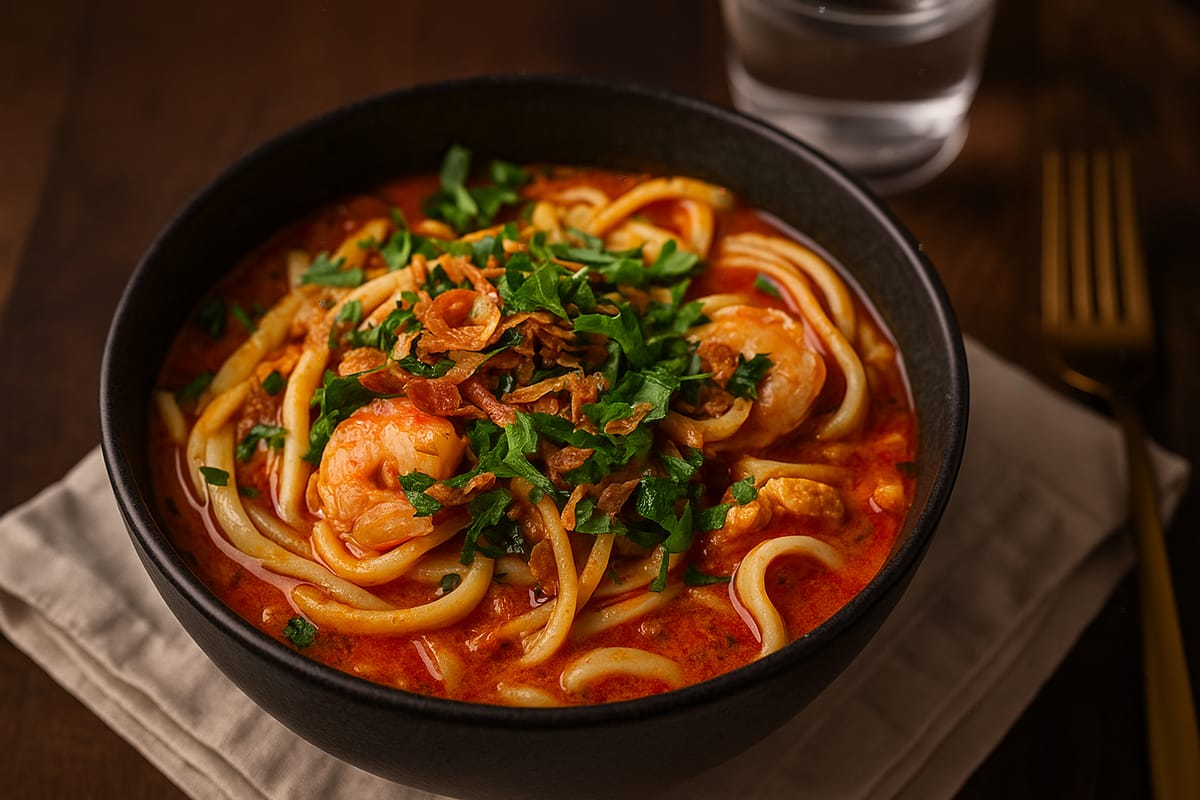
Indonesian Laksa – Smoked Fish Coconut Noodle Soup
Ingredients
Instruction
- Prepare the noodlesBoil sago noodles (or rice vermicelli) until chewy and tender. Drain and, if desired, shape into small bundles for serving.
- Make the spice pasteBlend shallots, garlic, candlenuts, turmeric, ginger, galangal, coriander, cumin, and chilies into a smooth paste.
- Cook the paste Heat 2–3 Tbsp oil in a pot. Sauté the spice paste until fragrant. Add lemongrass, bay leaves, cloves, cardamom, cinnamon, and nutmeg. Cook until aromatic.
- Add the fishStir in the flaked boiled fish and smoked fish. Cook briefly until the flavors meld.
- Build the broth Pour in the thin coconut milk. Simmer gently for 10–15 minutes, stirring occasionally. Season with salt, sugar, and bouillon powder (if using).
- Finish with thick coconut milkLower the heat, add the thick coconut milk, and stir gently. Do not let it boil hard to prevent curdling. Taste and adjust seasoning.
- Assemble and servePlace noodles in bowls. Ladle hot broth with smoked fish over the noodles. Garnish with daun kesum (or substitute), fried shallots, and serve with chili sambal on the side.
Notes
- moked fish (ikan asap): Traditionally, tongkol (mackerel tuna) or selar (scad) are used. If unavailable, substitute with smoked mackerel or smoked trout, which are more common in Western markets.
- Sago noodles (mie sagu): Unique to Riau and nearby islands, they can be replaced with rice vermicelli (bihun) or rice noodles if unavailable.
- Daun kesum (Vietnamese coriander): If you can’t find this herb, substitute with Thai basil or a mix of fresh cilantro + mint to mimic the peppery-fresh aroma.
- Spice level: Laksa is meant to be slightly spicy, but you can adjust by serving sambal (chili paste) on the side.
- Make-ahead tip: The broth develops deeper flavors if cooked a day in advance and reheated gently.
Where Does Laksa Come From?
The origins of this dish are as layered as its broth. Historians trace it to the Peranakan community—descendants of Chinese traders who married local Malay women. When Chinese sailors and merchants docked in places like the Riau Islands, Malacca, or Singapore, they brought with them wheat and rice noodles. Local wives then enriched those simple soups with santan (coconut milk), chili, and spices, transforming them into something entirely new.
This noodle soup is, therefore, a product of cultural fusion—a marriage not only of people but of culinary traditions.
The Persian and Indian Connection
Some scholars believe the word “laksa” itself comes from the Persian word lakhshah, meaning a type of noodle. Others connect it to Sanskrit “laksha”, meaning “one hundred thousand,” perhaps referencing the countless spices in the broth. Indian traders had been in Southeast Asia since 200 BCE, long before Chinese migration intensified. These connections suggest the meal may carry echoes of ancient Persian and Indian culinary routes along the Silk Road.
Laksa in Indonesia: Diverse and Local
Indonesia’s vast archipelago means this specialty doesn’t have one fixed recipe—it adapts. Each region puts its spin on it.
Laksa Bogor
- Origin: West Java
- Kuah (broth): Thick coconut milk base with oncom (fermented soybean cake), giving an earthy flavor.
- Carbs: Usually ketupat (rice cakes) and bihun (vermicelli).
- Toppings: Bean sprouts, boiled eggs, sambal cuka (vinegar-based chili sauce).
- Story: Once considered a dish for Javanese royals, this Bogor delicacy is now a street food staple. Vendors would carry it in baskets around neighborhoods until the 1960s.
Laksa Betawi (Jakarta)
- Kuah: Coconut-based but lighter, flavored with ebi (dried shrimp), lemongrass, and turmeric.
- Carbs: Lontong or bihun.
- Toppings: Fresh kemangi (basil), fried shallots, sometimes perkedel (potato fritters).
- Flavor: More shrimpy than smoky, often brighter in color.
Laksa Kepulauan Riau (Lakse Kepri)
- Kuah: Coconut milk infused with ikan asap (smoked fish), cloves, cinnamon, and nutmeg—showing strong Malay influence.
- Carbs: Mie sagu (sago noodles), chewy and unique.
- Toppings: Daun kesum (Vietnamese coriander), sambal, fried shallots.
- Character: Smoky, creamy, and herbaceous—very different from the chicken-based or ebi-rich versions on Java.
Laksa Beyond Indonesia
Malaysia
In Malaysia this comfort food is fiercely regional:
- Penang Assam Laksa: Tamarind-based broth, tangy and spicy, with mackerel as the main protein.
- Curry Laksa: Rich coconut curry broth with shrimp, tofu puffs, and fish cakes.
- A culinary identity so strong that political debates once erupted when Malaysia claimed the recipe as “their” dish.
Singapore
- Katong Laksa: Created by Peranakan migrants in the Katong neighborhood. Distinct because noodles are cut short so they can be eaten with just a spoon.
- Uses dried shrimp, coconut milk, and cockles for a briny punch.
Southern Thailand
- Laksa Siam: Often similar to Malaysian styles, with curry paste and coconut milk.
- The Thai influence means stronger chili heat and use of kaffir lime leaves.
Laksa as a Bridge of Cultures
This dish is not only food—it is a philosophy in a bowl. Behind every steaming ladle of coconut broth lies centuries of history, migration, and cultural blending. When Chinese traders arrived in the Malay archipelago, they brought with them noodles—symbols of their culinary heritage. Local women, often their wives, transformed these simple strands by infusing them with the richness of Southeast Asian flavors: coconut milk, chilies, lemongrass, and galangal. Out of this union, the bowl was born, becoming both a meal and a metaphor for human connection.
At its heart, the recipe reflects several timeless ideas:

- Adaptability: It shows how local cooks could take foreign ingredients and techniques, then transform them into something uniquely their own.
- Marriage across cultures: This noodle soup is literally the child of unions between Chinese men and Malay or Indonesian women, representing families, households, and culinary traditions merged into one.
- Diversity: Every region made the dish differently, yet all are still called by the same name. From Bogor with its earthy oncom to Riau with its smoky fish, each variation celebrates difference without losing identity.
This adaptability explains why the meal has survived and thrived for centuries. Like the Silk Road that once carried spices, languages, and ideas across continents, this comfort food too carries whispers of many worlds. You can taste the Persian word lakhshah, the Indian influence of spice traders, the Chinese passion for noodles, and the Malay mastery of coconut and herbs.
In every bowl, there is more than comfort food—it is a living story of trade, migration, love, and adaptation. To eat it is to taste the crossroads of civilizations, condensed into one fragrant, flavorful dish.
Health: Benefits and Risks
- Benefits:
- Coconut milk provides healthy fats that boost satiety.
- Herbs like turmeric, lemongrass, and galangal have anti-inflammatory properties.
- Fish-based versions offer lean protein and omega-3 fatty acids.
- Risks:
- Coconut milk is calorie-dense; one bowl can exceed 400 kcal.
- Some versions are high in sodium from dried shrimp or fish sauce.
- For those with lactose or nut allergies—good news, this specialty is dairy-free and nut-free if candlenuts are swapped.
How Laksa is Served in Indonesia
In Indonesia, this meal is often a breakfast or lunch dish, served at roadside stalls or during festivals.
- Tangerang style: Historically sold by street vendors walking through neighborhoods.
- Bogor version: Still popular in Suryakencana, Bogor, with locals queuing for a bowl.
- Betawi style: Common during festive gatherings in Jakarta.
- Melayu/Riau style: In Riau and the surrounding islands, the dish takes on a very different character. The broth is enriched with smoked fish (ikan asap such as mackerel or tuna), simmered in coconut milk with cloves, nutmeg, cinnamon, and lemongrass. The noodles are usually mie sagu (sago noodles), chewy and unique to the region, and the finishing touch is a sprinkle of daun kesum (Vietnamese coriander), giving a fresh, slightly peppery aroma. This version is often prepared for traditional ceremonies, communal feasts, and festive occasions, making it not only a meal but also a symbol of Malay cultural identity.
Each variation is hearty, meant to be shared, and often eaten with sambal to adjust the spice level.
Serving Suggestions for International Tables
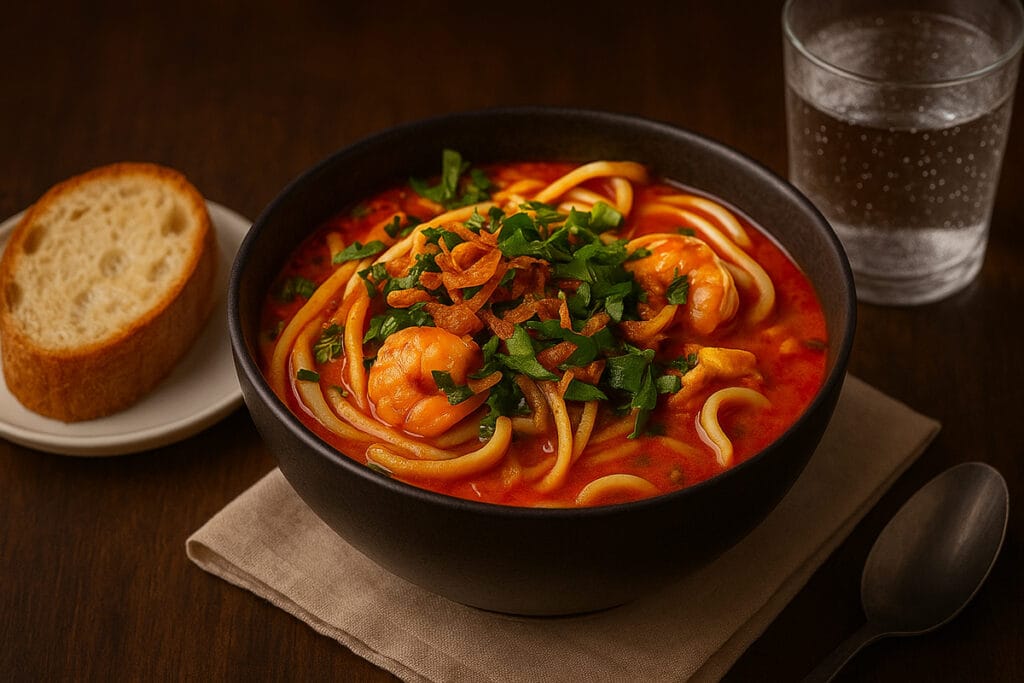
If you want to bring this delicacy to Western audiences:
- Pair with crusty bread (like sourdough) to soak up the broth.
- Offer steamed jasmine rice alongside for those who prefer grains.
- Wine pairing: a crisp dry Riesling or Sauvignon Blanc cuts through the richness.
- For non-alcoholic options: iced jasmine tea or sparkling water with lime works beautifully.
A Bowl That Tells a Thousand Stories
This noodle soup is more than a dish—it’s a history lesson in a bowl. From Persian words to Chinese noodles, from Malay spices to Indonesian creativity, it represents how food adapts, migrates, and connects people.
Whether you taste the smoky fish version from the Riau Islands, the earthy oncom broth of Bogor, or the tangy tamarind soup of Penang, you’re not just eating noodles—you’re experiencing centuries of trade, migration, and love stories.
So next time you hold a steaming bowl, remember: you’re not just eating soup. You’re tasting the story of Southeast Asia itself.