When I was a child growing up in Indonesia, weekend mornings often began with my father going for a walk. Unlike in Western countries, where morning walks usually take place in scenic parks or nature trails, in Indonesia these walks often happen around neighborhoods — sometimes ending up in the bustling traditional market. My father would return with plastic bags full of kue pasar (literally “market cakes”), a wide variety of traditional Indonesian snacks.
As a kid, I didn’t always appreciate them. Like many children, I was drawn more to Western-style cakes — black forest, cream-filled sponge cakes, or frosted tarts. My father, however, rarely brought those home. Instead, his bags were filled with sticky rice cakes, onde-onde (sesame balls), lupis, and — one of the most iconic of all — dadar gulung.
At first, I wasn’t too excited. A green roll filled with grated coconut didn’t look nearly as tempting as whipped cream or chocolate frosting. But one bite changed my mind. The soft, slightly chewy pancake wrapped around sweet, aromatic coconut cooked with palm sugar had a texture and flavor unlike anything else. The outside was smooth and tender, while the inside was pleasantly coarse and caramel-like. Over time, this little green roll became one of my favorites.
Today, dadar gulung (pronounced DAH-dahr GOO-loong) is still one of Indonesia’s most beloved traditional snacks, and its story is as fascinating as its flavor.
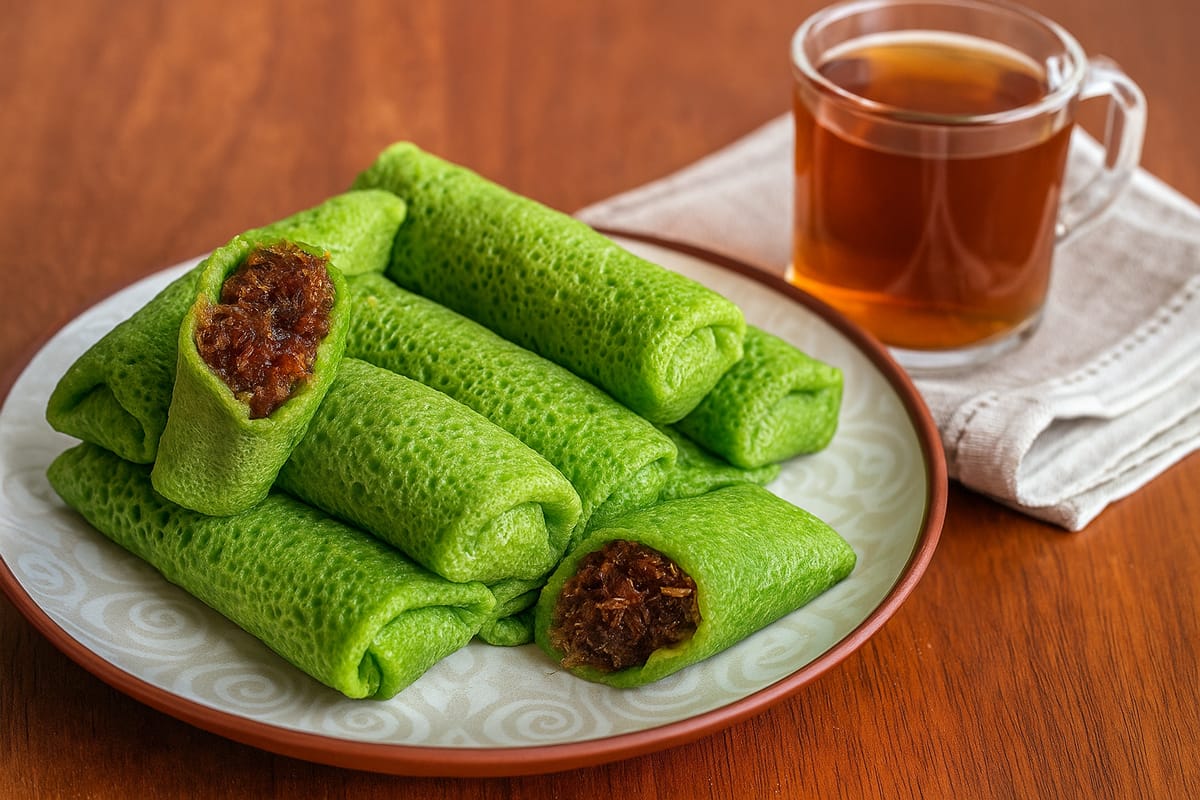
Indonesian Coconut Pancake Rolls (Dadar Gulung)
Ingredients
Instruction
- In a small saucepan, combine palm sugar, water, pandan leaves, and salt. Heat until the sugar melts into a syrup.
- Add grated coconut and stir well. Cook over medium heat until the mixture is sticky and slightly dry, but still moist enough to shape. Remove pandan leaves. Let cool.
- In a mixing bowl, whisk eggs, sugar, and salt until sugar dissolves.
- Add flour, then gradually whisk in the coconut milk until smooth and lump-free.
- Stir in pandan paste until the batter is light green and pourable.
- Heat a nonstick pan over medium heat and lightly brush with oil.
- Pour ¼ cup batter into the pan and swirl into a thin crêpe, about 8 inches (20 cm) in diameter.
- Cook until set (about 1–2 minutes), no need to flip. Transfer to a plate. Repeat until batter is finished.
- Place one wrapper on a clean surface. Add 3–4 tablespoons of coconut filling in the center.
- Fold in the sides, then roll tightly like a burrito or crêpe.
- Repeat with remaining wrappers and filling.
- Serve at room temperature as a snack or dessert.
Notes
- Pandan Substitute: If pandan paste isn’t available, use vanilla extract + green food coloring. The flavor won’t be identical but still tasty.
- Coconut Substitute: Fresh grated coconut (kelapa parut) gives the best texture. If unavailable, use unsweetened shredded coconut from American grocery stores. Rehydrate in hot water before cooking.
- Palm Sugar Substitute: Indonesian palm sugar (gula merah) has a smoky, caramel-like flavor. If unavailable, substitute with Thai palm sugar or dark brown sugar.
- Serving Style: Traditionally small (bite-sized), but for Western appetites, make larger rolls (8 inches/20 cm crêpes) for a satisfying dessert portion.
What is Dadar Gulung?
The name comes directly from the way it is made: dadar means “to spread thin batter like a crêpe,” while gulung means “to roll.” Essentially, it’s a pandan-flavored crêpe rolled around a filling of grated coconut and palm sugar, a mixture called unti kelapa in Indonesia.
The green color is traditionally derived from the juice of pandan or suji leaves, both used widely in Indonesian cooking for their aroma and natural coloring. The pancake itself is thin and soft, much like a French crêpe, but it is uniquely Southeast Asian in taste.
A Glimpse Into History
Like many dishes in Indonesia, dadar gulung carries layers of history and cultural exchange. Its origins are not tied to just one story, but several perspectives that together paint a rich picture:
- Colonial Influence (Betawi–Dutch Connection): During the Dutch colonial era, European pancakes (pannenkoeken) were introduced. In areas like Depok, which had strong Dutch cultural influence, locals combined the concept of Dutch pancakes with Betawi flavors, filling the soft green crêpes with grated coconut and palm sugar. This blend of cultures gave rise to the dadar gulung we know today.
- Malay and Regional Roots: In the broader Malay world, similar snacks are known as kuih ketayap (Malaysia) or kuih lenggang (Sabah dialect). In Tamil Nadu, India, a related dish called surul appam is also enjoyed. These connections show that dadar gulung belongs to a family of rolled pancakes spread across Asia, each adapted to local traditions.
- European Pancake Lineage: Some culinary historians trace dadar gulung back even further, linking it to the evolution of pancakes in Europe. Pancakes were already popular in the 15th century, known in Germany as pfannkuchen, in France as crêpes, and in America under various names. Over centuries, this style of food traveled and took root in Southeast Asia, eventually becoming the coconut-filled rolls we recognize today.
- Local Adaptation by Indonesian Workers: Another account suggests that indigenous laborers working on Dutch plantations adapted European pancakes with ingredients available locally. Since dairy products were rare and expensive, they used flour, grated coconut, and palm sugar — creating a uniquely Indonesian version.
Across these stories, one theme is consistent: dadar gulung is both a symbol of adaptation and creativity. Whether born from colonial encounters, Malay culinary traditions, or global pancake culture, it remains firmly Indonesian at heart.
The Philosophy Behind Dadar Gulung
Beyond its taste and history, dadar gulung also carries cultural symbolism in Javanese tradition.
- The Green Color: Traditionally derived from pandan or suji leaves, green represents fertility, prosperity, and harmony with nature.
- The Neat Roll: Its tidy, compact form reflects values of togetherness, order, and unity in community life.
- Ceremonial Role: Dadar gulung is often served at weddings, communal feasts, and religious gatherings as a symbol of joy, blessing, and shared happiness.
This philosophy reminds Indonesians that food is not just about nourishment, but also about meaning, ritual, and connection — something that makes dadar gulung more than just a sweet snack.
From Simplicity to Modern Variations
Traditionally, dadar gulung contains only grated coconut and palm sugar. But as culinary creativity expanded, so did the varieties:
- Chocolate dadar gulung: The pancake or filling flavored with cocoa.
- Cheese-filled: A modern fusion of sweet and savory, mixing grated cheese with the coconut.
- Red velvet or matcha rolls: Using beetroot or green tea powder for contemporary color and taste.
- Fruit-filled versions: Bananas, avocados, or mangoes tucked inside for a tropical twist.
This evolution mirrors Indonesia’s vibrant food scene — rooted in tradition yet open to innovation.
Nutrition and Benefits
At its core, dadar gulung is made from natural, unprocessed ingredients:

- Coconut: Provides healthy fats, fiber, and minerals such as manganese.
- Palm sugar: While still a sugar, it is less processed than refined white sugar and carries a deep, caramel-like flavor.
- Pandan: Often called “the vanilla of Southeast Asia,” pandan offers not only fragrance but also antioxidants.
Though it is still a sweet treat, it is relatively wholesome compared to heavily processed Western desserts.
How It’s Served in Indonesia
In Indonesia, dadar gulung is found everywhere — from street vendors and traditional markets (pasar) to upscale hotels offering Indonesian dessert buffets. It’s usually served at room temperature on a small plate, often paired with a cup of hot tea or coffee.
Its small, snackable size makes it perfect for sharing during gatherings, or as a mid-morning snack between meals.
Bringing Dadar Gulung to the West
For Western audiences, dadar gulung has a familiar form. After all, it resembles a rolled crêpe or even a small burrito, making it less intimidating to try. Its sweet, nutty filling has similarities to coconut macaroons, while the soft wrapper will remind many of crêpes or pancakes.
Serving Suggestions for Western Tables:
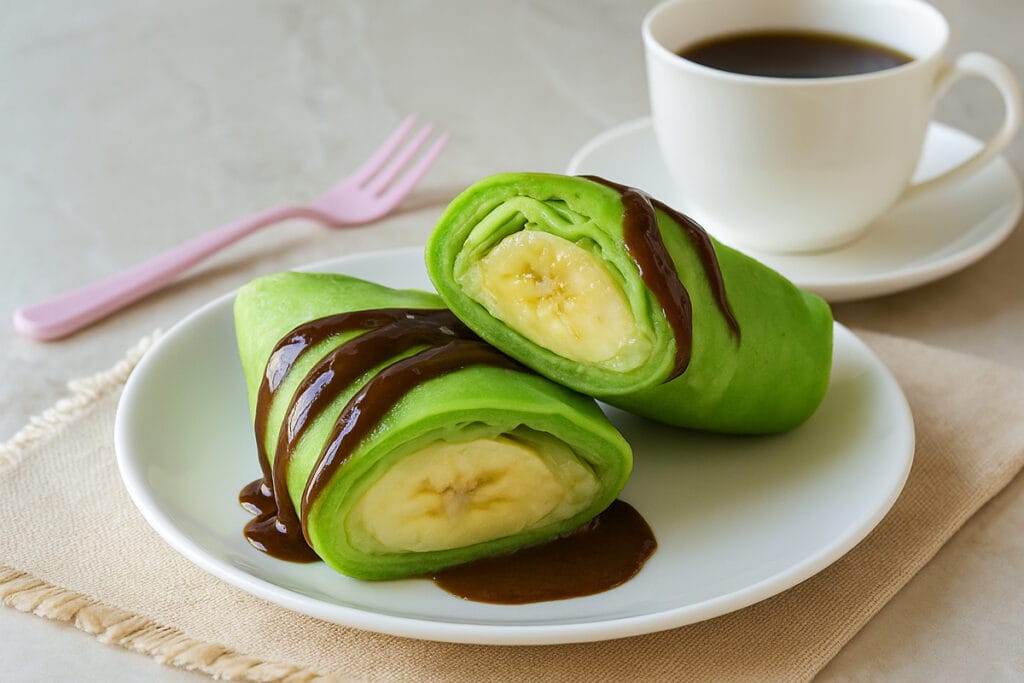
- Present them warm with a drizzle of chocolate sauce for a fusion dessert.
- Serve as part of an “Asian dessert platter” alongside mochi, mango sticky rice, or coconut jelly.
- Plate elegantly with powdered sugar dusting for dinner parties.
The flavor profile is friendly to Western palates — nutty, caramel-sweet, and slightly tropical. For anyone who loves crêpes, this dish feels like a natural extension.
Global Parallels
Dadar gulung is not alone in the world of filled pancakes. Similar dishes exist across cultures:
- French crêpes: Often filled with Nutella, fruit, or cream.
- German Pfannkuchen: A thicker pancake sometimes filled with fruit preserves.
- Malaysian Kuih Ketayap: Almost identical to dadar gulung, highlighting shared culinary heritage.
- Indian Surul Appam: Coconut-filled rolled pancakes made for festivals.
These parallels make dadar gulung both exotic and relatable at the same time.
Tips to Get It Right
While dadar gulung is simple, there are a few keys to success:

- Batter Consistency: It should be thin and smooth, like crêpe batter. Strain if needed.
- Nonstick Pan: Essential for making delicate pancakes without tearing.
- Coconut Filling: Don’t overcook — it should be moist, not dry, to balance the soft wrapper.
- Rolling Technique: Fold sides inward first, then roll tightly so filling doesn’t fall out.
- Use Pandan if Possible: Its aroma is what makes dadar gulung truly Indonesian.
Why Westerners Will Love It
For Western eaters, dadar gulung hits the sweet spot between familiar and new. It is essentially a coconut crêpe roll — approachable, handheld, and visually appealing. Unlike some Asian desserts that rely heavily on sticky rice or beans, dadar gulung uses flavors that are already beloved in the West: coconut, caramel, and soft pancakes.
It bridges cultures in a single bite — as comforting as pancakes, yet uniquely Indonesian.
Why Dadar Gulung Deserves a Spot on Your Table
Dadar gulung may look like a simple green roll, but it carries centuries of history, cultural symbolism, and evolving flavors. For Indonesians, it is nostalgia wrapped in pandan-scented crêpes. For Western audiences, it is an invitation to taste Southeast Asia in a form that feels both exotic and familiar.
From my childhood memories of my father bringing home bags of kue pasar to the modern dessert tables of Indonesian weddings, dadar gulung remains timeless. And just like pancakes, it proves that across cultures, sometimes the simplest foods — flour, eggs, sugar, and a little imagination — can bring the most joy.