Empal Gentong is not just a dish — it’s a story of culture, spirituality, and culinary legacy from the city of Cirebon, West Java, Indonesia. At first glance, it may appear like another creamy curry, but behind the rich yellow broth and tender beef lies a centuries-old heritage that connects food, faith, and philosophy.
What is “Empal” and What is “Gentong”?
The name Empal Gentong consists of two key words:
- Empal traditionally refers to seasoned and cooked beef — usually boiled, fried, or stewed — until tender. In West Java, empal is commonly made from beef brisket or other flavorful cuts. When combined with coconut milk and spices, it transforms into a deeply aromatic dish.
- Gentong means clay pot in the Sundanese and Cirebon dialects. The dish earned its name because it was historically cooked in a large earthenware pot over firewood, allowing the flavors to develop slowly and naturally.
So Empal Gentong quite literally means “beef curry in a clay pot.”

Empal Gentong (Cirebon-Style Beef Offal Curry)
Ingredients
Instruction
- Clean the offal thoroughlyRinse liver and spleen with water and a squeeze of lime or vinegar to remove any strong odor. Boil briefly and drain.
- Boil the beef and offal separately until tender. Remove and cut into bite-sized cubes. Reserve 500 ml of the beef stock for the broth.
- In a large pot, heat oil and sauté the spice paste together with bay leaves and lemongrass over medium heat until fragrant and the paste turns a bit oily (about 5–7 minutes).
- Add the cooked beef and offal pieces. Stir well to coat them evenly with the spices.
- Pour in the beef stock and thin coconut milk. Bring to a gentle simmer over medium heat. Let it cook uncovered until the broth reduces by about half.
- Lower the heat and stir in the thick coconut milk. Simmer gently (do not boil) until the curry thickens and oil begins to surface on top.
- Taste and adjust seasoning with more salt or bouillon if desired.
- Serve hot, topped with sliced scallion and crispy fried shallots.
Notes
- Coconut milk: You can use canned coconut milk. To substitute fresh: dilute full-fat canned coconut milk with water (2:1 ratio) for thin, and use undiluted for thick coconut milk.
- Candlenuts (kemiri): Common in Indonesian cooking for creamy texture; macadamia nuts are the best Western substitute.
- Daun salam (Indonesian bay leaf): Not the same as Western bay leaf, but if unavailable, use regular bay leaf or skip.
- Beef offal: If spleen or liver is unavailable or too exotic for your guests, feel free to use only beef brisket or add beef tendon or tripe (cleaned well).
- Serving suggestion: Traditionally served with steamed rice or lontong (compressed rice cake) and sometimes with krupuk kulit (crispy beef skin crackers) or emping (melinjo nut crackers).
The Origins and History of Empal Gentong
Empal Gentong is believed to have originated from the Cirebon Sultanate era, around the 15th to 16th century, when Cirebon was a thriving port and cultural melting pot. As a center for trade and religious learning, Cirebon attracted merchants and missionaries from the Middle East, China, and India. These influences subtly shaped the region’s culinary traditions — including the use of coconut milk, spices, and slow cooking methods.
The use of jerohan (offal), such as liver and spleen, in Empal Gentong reflects local culinary practicality — making use of the whole animal, in line with traditional halal slaughter and minimizing waste.
It was traditionally cooked during special occasions or religious events, especially Eid al-Adha (Hari Raya Qurban) when beef was abundant and communal meals were prepared for the whole village.
Cultural and Philosophical Meaning
Empal Gentong is more than just a traditional dish — it carries deep cultural symbolism and reflects local values in a unique way. Some cultural interpretations view this dish as a metaphor for the relationship between humans, morality, and law:
- The beef represents humankind — people in their raw state, with behavior and tendencies that may not always be pleasant or meaningful to others.
- The rich, spiced coconut broth symbolizes spiritual or moral values that enhance and refine human behavior, making it more harmonious, balanced, and beautiful.
- The gentong (traditional clay pot) stands for rules, laws, and social norms that guide and contain human actions, much like the pot contains and shapes the flavor of the stew.
When cooked together, these elements form a powerful metaphor: humans (beef) become more meaningful and refined when shaped by values (the broth) and bound by structure and ethics (the pot). This is why many locals believe the flavor of Empal Gentong remains at its best when cooked in a traditional clay pot — just as human behavior stays in harmony when guided by faith, discipline, and community values.
Characteristics of Empal Gentong
Empal Gentong is rich, golden-yellow, and savory. Its key features include:
- Aromatic spice blend (bumbu halus) made from shallots, garlic, turmeric, candlenut, and pepper.
- Coconut milk broth that is both creamy and earthy.
- Tender beef and offal, simmered slowly to absorb all the spices.
- Cooked in clay pot, traditionally, but modern kitchens use steel or ceramic pots.
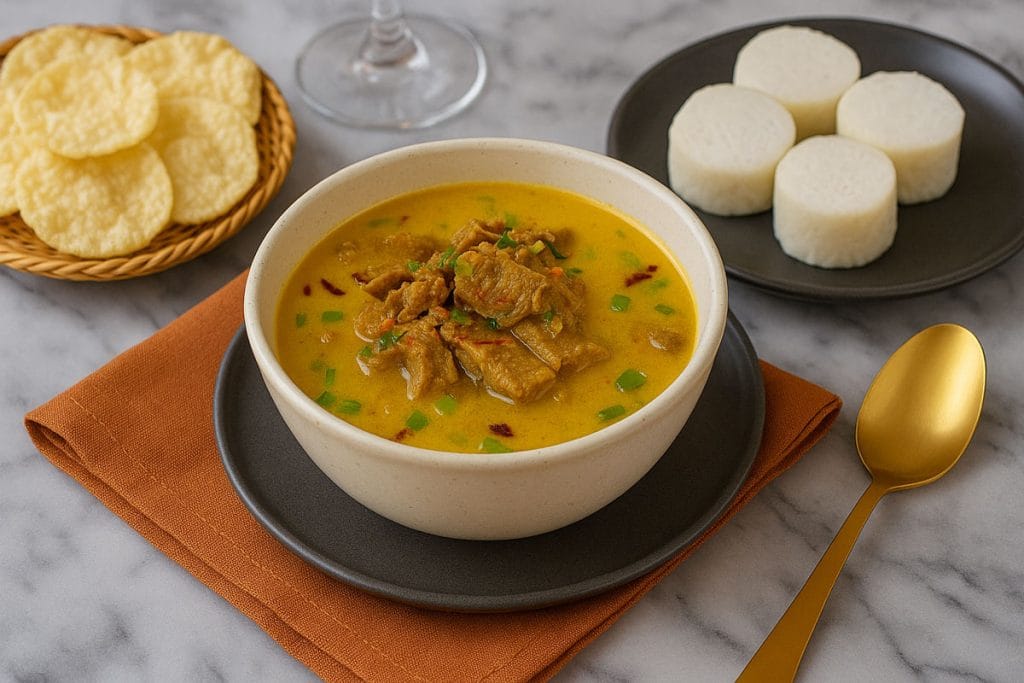
- Topped with scallions and fried shallots, sometimes accompanied by crackers (kerupuk kulit) and steamed rice or lontong (compressed rice cakes).
How to Eat Empal Gentong
The dish is typically served hot, with a spoonful of rice or lontong dipped directly into the rich curry. For locals, kerupuk kulit (crispy beef skin crackers) is the perfect pairing, adding texture and a savory crunch. Some even add a splash of sambal for extra heat.
When is Empal Gentong Traditionally Served?
Traditionally, Empal Gentong is prepared during:

- Religious festivals, especially Idul Adha where beef is abundant.
- Traditional ceremonies and family gatherings in Cirebon.
- Special days like weddings or community feasts.
It is also a popular street food in Cirebon, especially in the Empal Gentong Street area near Jalan Slamet Riyadi, where clay pots line up beside steaming fires.
Is Empal Gentong Suitable for International Kitchens?
Absolutely — Empal Gentong is both approachable and adaptable for home cooks outside Indonesia. The cooking method is straightforward and shares similarities with many international stews and curries: blending spices, sautéing, simmering, and letting the flavors develop slowly.
Here are a few adjustments to make it easier for Western kitchens:
- Use beef only: If offal like liver or spleen is unfamiliar or hard to find, just use brisket, chuck, or stewing beef.
- Coconut milk: Canned coconut milk works well. Dilute for thin coconut milk; use undiluted for thick.
- Pot alternatives: No clay pot? A Dutch oven, heavy-bottomed pot, or slow cooker will do just fine.
- Spice substitutes: Turmeric powder and white pepper are common. If you can’t find candlenuts (kemiri), use macadamia nuts instead.
And yes, the flavor profile suits Western palates very well. The dish is rich, creamy, savory, and mildly spiced — often compared to a cross between Thai coconut curry and hearty beef stew.
If you’re introducing this dish to guests, you can start with beef only, then explore jeroan (offal) once they’re ready for something more adventurous. Those who enjoy butter chicken, green curry, or Moroccan tagine will likely appreciate the warmth and depth of Empal Gentong.
A Dish That Preserves Identity
Empal Gentong continues to stand the test of time. Despite globalization, it remains rooted in local values — as a vessel of both taste and teaching. In a world where fast food dominates, a dish like this reminds us of the value of slow cooking, community, and cultural wisdom.
For Indonesians abroad or curious food lovers in the West, cooking Empal Gentong is more than recreating a recipe — it’s about preserving an identity, tasting history, and understanding a philosophy.
If you’re an international cook looking to explore the deeper side of Indonesian cuisine, Empal Gentong is a perfect starting point — complex in meaning, yet warm and inviting in every bite.