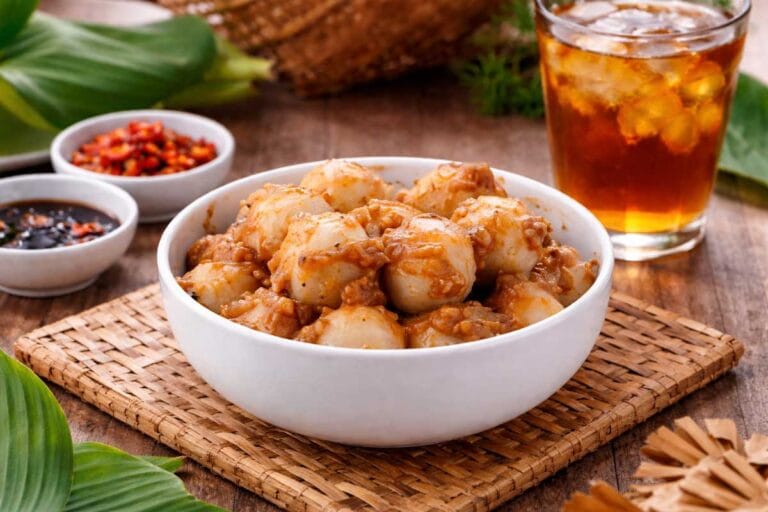
If you’ve ever tasted Pempek—Indonesia’s iconic fishcake delicacy from Palembang, South Sumatra—you’ll know that one thing truly brings it to life: the dark, aromatic dipping sauce known as Cuko. Pronounced “choo-ko,” this sauce is more than just a condiment. It’s the soul of the dish, the spark that balances and elevates every chewy bite of Pempek.
But what exactly is Cuko? And why does it matter so much to the dish it’s paired with?
Let’s take a flavorful journey into the heart of this Indonesian treasure.

Cuko Sauce (Spicy Palm Sugar Tamarind Sauce for Pempek)
Ingredients
Instruction
- In a saucepan, combine palm sugar, tamarind pulp, and water. Bring to a boil and simmer until sugar dissolves. Strain to remove tamarind fibers.
- Blend garlic, soaked ebi, and chilies into a coarse paste. Add this paste into the strained tamarind-sugar mixture.
- Stir in salt and simmer again until the sauce slightly thickens but is still pourable.
- Let it cool completely. For best flavor, let the sauce rest overnight in the fridge.
Notes
- You can find gula aren in Asian or international stores. If unavailable, use dark brown sugar or Thai palm sugar as a substitute.
- Ebi (dried shrimp) should be soaked in hot water, rinsed, and drained before blending. For deeper flavor, you can also turn it into ebi powder by dry-roasting and grinding.
- The sauce should be slightly thick, not syrupy. It’s meant to cling lightly to pempek, not smother it.
- This sauce pairs best with Pempek Kapal Selam or other Indonesian fish cakes, and is traditionally served with diced cucumber.
A Sauce With Deep Roots and Deep Flavor
Cuko is made from a blend of natural ingredients: rich gula aren (Indonesian palm sugar), asam jawa (tamarind pulp), garlic, dried shrimp (ebi), and fiery bird’s eye chilies. These are simmered slowly with water and a pinch of salt to create a glossy, dark brown sauce that’s sweet, tangy, slightly salty, and spicy all at once.
In many parts of Indonesia today, especially outside of Palembang, you might find imitation versions of Cuko. To cut corners, vendors often substitute real tamarind with synthetic vinegar. While this may produce a similar level of sourness, it lacks the complexity and mellow tang that only tamarind can bring.
In many parts of Indonesia today, especially outside of Palembang, you might find imitation versions of Cuko. To cut corners, vendors often substitute real tamarind with synthetic vinegar. While this may produce a similar level of sourness, it lacks the complexity and mellow tang that only tamarind can bring.
Additionally, vinegar can irritate the stomach lining, especially for people with acid reflux or sensitive digestion—a concern that’s increasingly common in the United States and Europe. Tamarind, on the other hand, offers a gentler acidity that’s less likely to trigger discomfort, making it a better choice not just for authenticity, but also for digestive health.
Real asam jawa contributes not just sourness but also depth and a slightly fruity aroma. Vinegar, on the other hand, gives a sharp, flat acidity that can overpower the balance. For a true experience of Pempek Palembang, the sauce must honor the original ingredients.
The Philosophy of Cuko Pempek
Like much of Indonesian cuisine, Cuko is more than a recipe—it’s a reflection of philosophy and culture. In Palembang, people often say that “pempek is not pempek without cuko.” The two are inseparable, like old friends who complete each other. This idea symbolizes loyalty—how some things are simply better when together.
But there’s a deeper metaphor at play. Cuko teaches us about balance in life.
Sweetness from palm sugar, sourness from tamarind, saltiness, and heat from chili—no one element dominates. Instead, they harmonize to create something greater than the sum of its parts. Just like life, which brings joy, sorrow, comfort, and challenge all at once, Cuko reminds us that wholeness comes from accepting complexity.
Eating Pempek without Cuko might still be tasty—but it would be missing its soul.
Why It Might Just Win Over Western Taste Buds
Western palates already enjoy sweet-and-sour pairings—think barbecue sauce, teriyaki glaze, or even Worcestershire sauce. In that sense, Cuko is not so foreign. What makes it unique is the combination of palm sugar’s deep molasses-like sweetness with savory shrimp and the earthy sourness of tamarind.

In fact, food lovers who enjoy Southeast Asian or Caribbean cuisine will likely fall in love with this sauce at first dip. Try drizzling it not just on Pempek, but over grilled tofu, roasted vegetables, or even crispy chicken wings. Its bold character complements a range of flavors.
A Taste of Memory and Heritage
For many Indonesians, including myself, Cuko brings back warm memories. I still remember my first experience tasting Pempek with authentic Cuko in Palembang in the 1990s. There were no apps, no Google Maps. The roads were rough, the city still quietly proud of its culinary heritage. I was taken to a humble Pempek shop just a short walk from home—nothing fancy, just a modest stall, but with Pempek so good it became part of my daily routine.

What struck me wasn’t just the chewy fishcakes, but the way the sauce completed the experience. It clung to the Pempek in just the right amount. It was sharp, comforting, and complex. And once I learned how to make it from scratch, I realized how it reflects the wisdom of generations.
Final Thought: A Sauce That Speaks
Cuko is not just sauce—it’s a conversation between flavor and feeling, tradition and modern taste. Whether you’re an adventurous foodie in America or a home cook in Europe, exploring Indonesian cuisine through Pempek and its inseparable companion Cuko is a delicious way to understand another culture.
So next time you reach for that bottle of chili sauce or sweet soy, consider making your own Cuko instead. It might just become your new favorite way to balance life—one sweet, sour, and spicy bite at a time.