If you’re a fan of Asian street food, chances are you’ve tasted dumplings in one form or another—Chinese dim sum, Japanese gyoza, Korean mandu. But have you heard of Siomay Bandung? This Indonesian steamed fish dumpling, slathered in rich peanut sauce and served with a medley of vegetables, is more than just a meal—it’s a cultural bridge between China and Indonesia, a childhood memory for many Indonesians, and a flavorful surprise for Western palates.
Let me tell you how this dish isn’t just food—it’s personal.
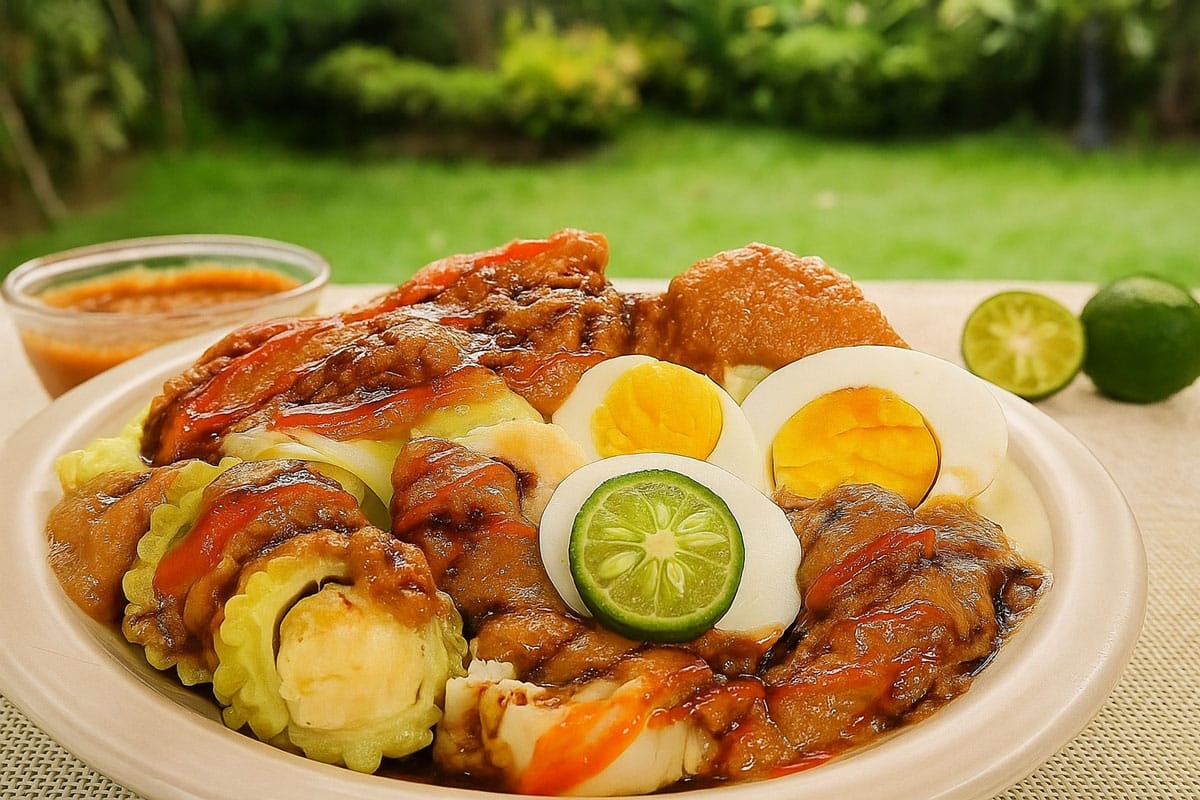
Siomay Bandung, Indonesian Steamed Fish Dumplings with Peanut Sauce
Ingredients
Instruction
- In a large bowl, mix ground fish, chicken, shrimp, egg, tapioca starch, and all seasoning ingredients. Stir or knead until the mixture is smooth and sticky.
- If using wonton wrappers: place 1 tablespoon of the mixture in the center of each wrapper, gather the edges to form a pouch or cone.
- For bitter melon: fill the hollow centers with the dumpling mixture.
- Shape remaining mixture into small balls or oval dumplings.
- Arrange dumplings, stuffed bitter melon, tofu, potatoes, cabbage rolls, and eggs in a steamer.
- Steam for 25–30 minutes, or until fully cooked and firm.
- In a small saucepan, combine ground peanuts, fried garlic, chili, candlenuts, coconut milk, sugar, and salt.
- Bring to a gentle boil over medium heat, stirring constantly to prevent curdling.
- Simmer until the sauce thickens and becomes creamy, about 10–15 minutes.
- Arrange steamed dumplings, vegetables, tofu, and egg on a plate.
- Generously pour warm peanut sauce over the top.
- Optional: drizzle with sweet soy sauce (kecap manis), chili sauce, and a squeeze of lime or calamansi juice before serving.
Notes
- Fish substitution: Mackerel (ikan tenggiri) has a strong flavor typical in Southeast Asian cuisine. Cod or pollock are milder and more accessible alternatives.
- Tapioca starch: Labeled as cassava flour or tapioca flour in most Asian or Latin American markets. Do not substitute with corn starch.
- Candlenuts (kemiri): These nuts add creaminess and a distinct taste. If unavailable, use macadamia or unsalted cashew nuts.
- Bitter melon (pare): This is quite bitter and may be an acquired taste. You can omit it or substitute with zucchini rings for a similar look without the bitterness.
- Wonton wrappers: Not traditionally used in authentic Siomay Bandung, but common in modern versions. You can skip them and steam the dumplings directly.
- Coconut milk: Use full-fat canned coconut milk for best results. If unavailable, peanut butter diluted with warm water can be a backup, though the taste will differ.
- Sweet soy sauce (kecap manis): This is a thick, sweetened soy sauce. Can be found in Asian markets or online. Optional but highly recommended for authentic flavor.
A Childhood Memory Steamed in Time
Back when I was a kid growing up in a residential neighborhood in Indonesia, the evening often came with sounds: crickets chirping, children playing, and then that familiar voice from a distance—
“Siomaaayyyyy…”
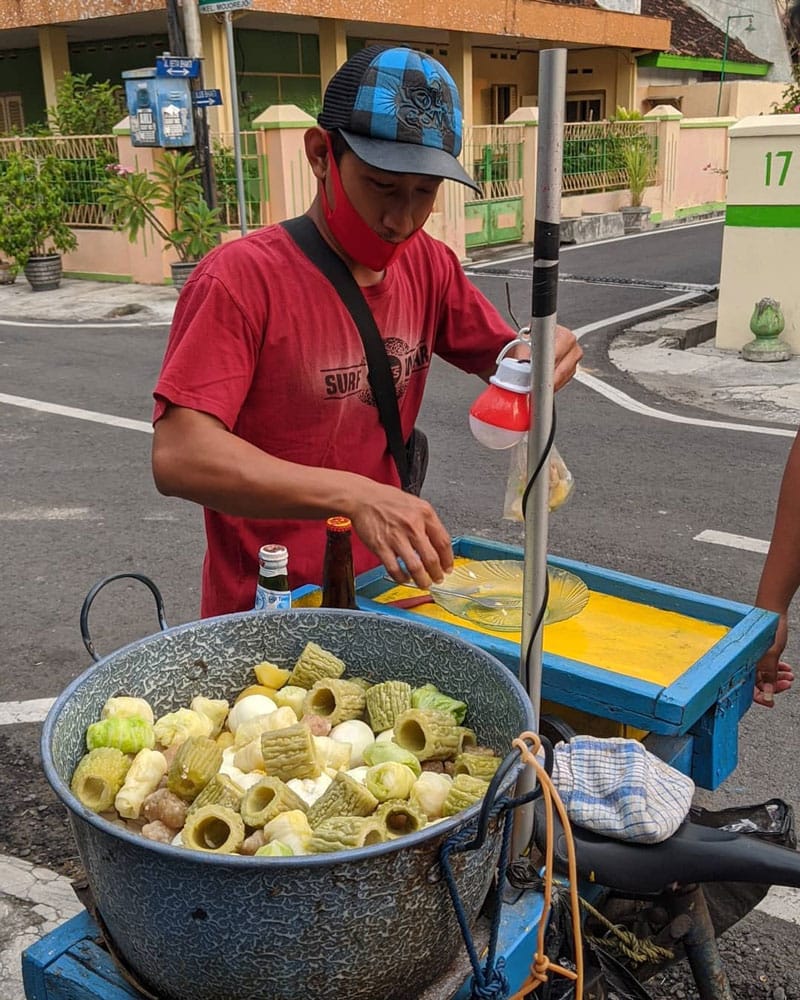
That was the signal. A man on a bicycle, carrying a wooden steamer box, was selling one of Indonesia’s most comforting street snacks. I used to think siomay was a soup (I loved soupy foods back then). So, the first time I saw it—cut-up dumplings, tofu, steamed cabbage and potatoes, all drowned in thick peanut sauce—I was a little confused. It wasn’t what I expected.
But then I took a bite.
It was nutty, savory, slightly spicy, warm, soft, and chewy—and then that final squeeze of jeruk sambal (tiny key-lime-like citrus) took it to another level. I was hooked. It became my go-to when I wasn’t having Padang rice (another comfort favorite). Even now, decades later, that memory comes rushing back with every bite.

From Shaomai to Siomay: A Culinary Migration
Siomay finds its origins in shaomai, a popular Chinese dumpling that dates back to the Yuan Dynasty (1271–1368). Traditionally, shaomai was made with minced pork, mushrooms, and sometimes shrimp, wrapped in a thin flour skin and steamed. It was often enjoyed in tea houses during yum cha—the Chinese tea-and-snack tradition still alive today.
When Chinese immigrants came to the Indonesian archipelago between the 16th and 19th centuries, they brought shaomai along. But there was a catch: Indonesia is a Muslim-majority country, and pork wasn’t a viable option. The Chinese community, especially in Bandung, began substituting pork with fish—specifically, tenggiri (mackerel)—and adding local touches like peanut sauce and steamed vegetables.
That’s how Siomay Bandung was born.
The Birthplace: Bandung, West Java
While siomay is now enjoyed all over Indonesia, Bandung, the capital of West Java, is its home. Known for its cool weather, creative culinary culture, and rich Sundanese traditions, Bandung embraced siomay as its own.
Legend has it that in the 1950s, a woman named Ceu Hani introduced siomay during a cooking competition celebrating Cap Go Meh (a Chinese-Indonesian festival). Her version used mackerel, tofu, bitter melon, and cabbage—steamed and served with peanut sauce. It won hearts and stomachs alike.
Soon, her recipe was sold around the city by street vendors pushing wooden carts or riding bicycles, shouting “Siomay!” through neighborhoods, just like the one from my childhood.
Today, “Siomay Bandung” is a name you’ll find printed on food carts from Java to Sumatra. And most likely, the seller will have a thick Sundanese accent—a subtle but proud cultural signature.
What’s in a Plate of Siomay?
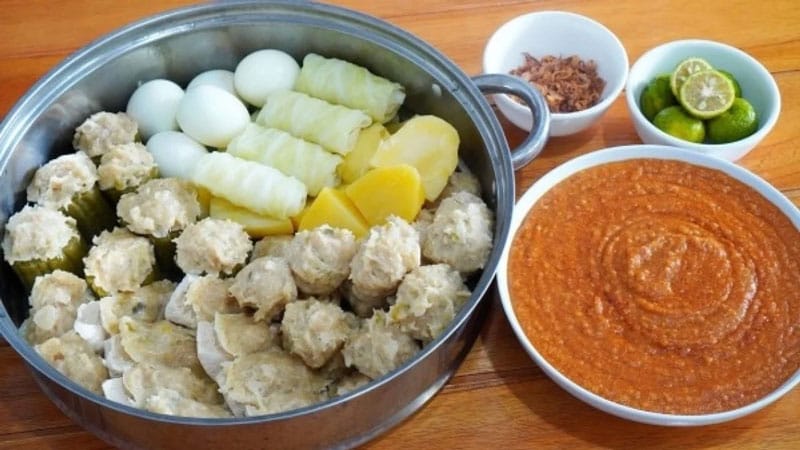
A typical serving of Siomay Bandung includes:
- Steamed dumplings made from a mixture of ground mackerel (ikan tenggiri), chicken, shrimp, tapioca starch, egg, garlic, and scallions.
- Stuffed bitter melon (pare) – a slightly bitter vegetable that’s filled with the same dumpling mixture.
- Steamed tofu (tahu) – often triangle-shaped and filled or topped with dumpling mix.
- Boiled potatoes
- Rolled cabbage (kol)
- Hard-boiled eggs
All of this is chopped into bite-sized pieces and topped with:
- A creamy, spicy peanut sauce
- Sweet soy sauce (kecap manis)
- A dash of chili sauce
- And a squeeze of jeruk sambal – a small lime-like citrus unique to Indonesia
This combination creates a flavor profile that’s nutty, salty, sweet, spicy, and citrusy all at once—a perfect example of balance in Southeast Asian cooking.
Is It for Western Palates?
Absolutely.

If you’re familiar with satay (Indonesian skewered meat) or Thai peanut noodles, the peanut sauce here won’t be foreign. The dumpling texture is comforting—think of a softer gnocchi or chewy fish ball. The bold flavors of sweet soy and citrus make it both familiar and unique.
That said, you may want to:
- Skip the bitter melon if you’re not a fan of bitter vegetables (zucchini is a great substitute).
- Adjust the spice level by controlling the chili sauce.
- Use lime instead of jeruk sambal, though the flavor is slightly less floral.
Siomay is hearty, protein-packed, and gluten-free if you skip the optional wonton skins. It’s versatile enough to be a snack, a light meal, or a satisfying lunch.
Ingredients, Westernized
To recreate Siomay Bandung at home, here’s a simplified ingredient guide:
- Fish: Mackerel (tenggiri) is best. Cod or pollock work well too.
- Tapioca starch: Found in Asian or Latin American stores (also called cassava flour).
- Candlenuts (kemiri): Can be substituted with macadamia or cashew nuts in peanut sauce.
- Sweet soy sauce (kecap manis): Available online or in Asian markets. You can also mix regular soy sauce with brown sugar as a substitute.
- Jeruk sambal: Use lime juice as an alternative.
Where Can You Find Siomay Today?
In Indonesia, siomay is sold:
- By street vendors on bicycles or pushcarts
- Around schools, from elementary to high school
- In office areas during lunchtime
- In food courts, warungs (local diners), and modern restaurants
- Alongside batagor – a fried version of siomay that’s also extremely popular in Bandung
Outside of Indonesia, you might spot siomay in:
- Indonesian restaurants in the Netherlands, California, or Sydney, where the diaspora is strong.
- Asian food festivals.
- Or—best of all—you can make it yourself at home.
Siomay and the Spirit of Fusion
Siomay is more than food—it’s a story of migration, adaptation, and innovation. It began in China as shaomai, transformed in Indonesia through faith and resourcefulness, and continues to evolve with modern tastes.
Today, there are fried siomay, vegetarian siomay, even batagor-siomay hybrids, showing how cultures blend and morph through something as simple as a street snack.

In a way, the dish reflects the best of global cuisine: a dish that crosses borders, yet never loses its roots.
In fact, Siomay has gained international recognition. In 2024, TasteAtlas ranked Siomay Bandung as the #1 best dumpling in the world, praising its rich flavors and cultural depth. This humble street food from Indonesia is no longer just local—it’s globally celebrated.
Final Bite
The next time you’re craving dumplings, skip the usual and try Siomay Bandung. It’s comforting yet bold, unfamiliar yet strangely nostalgic. Whether you’re Indonesian, Chinese, American, or anywhere in between, there’s something about siomay that feels like home.
That’s how food evolves—blending one method with another, one culture with the next. Siomay is a perfect example of that innovation.
And if you ever find yourself walking down a quiet street in Indonesia and hear a distant call—
“Siomaaayyyy…”
—follow it.
You might just find a plate of warm memories waiting for you.